Monday, June 17, 2013

Paul Getty - Failure of Wealth

Beauty shot Photo of the book The Great Getty over a anodized metallic table
The Great Getty
A social misfit with deep emotional insecurities and a massive Narcissus Complex, J. Paul Getty was otherwise an average rich guy. Well, maybe an average richest guy. This is the impression I kept from the famous tycoon after reading The Great Getty by Robert Lenzner. One would think that Mr. Lenzner titled the book with every intention to being sarcastic.
Recognized by Fortune magazine and the Guinness Book of Records as the richest man in America, Getty had an equally expansive sexual appetite. Going from lady to lady proved his inability to relate to those close to him. Evidently, this problem drove many of his so called loved ones to suicide, drug additions and many other emotional ailments.
He was famous for being a miser. Once, Getty installed a pay phone in his Tudor mansion near London to stop dignitaries who visited him from using the phone for international calls.
When the builder charged with constructing his beloved Getty Art Museum in LA decided to expense an electric pencil sharpener, Getty reprimanded him. Getty liked to review every single expense.
More relevant to the subject of this blog, Getty proved to be so full of himself and insecure that he failed miserably at creating great leaders behind him. Constant put downs, which are normal from this type of control seeking personality, created deep insecurities among those closest to him; including his sons. As a micro-manager, he did not professionally develop a single employee despite a massive network of corporations with lots of potential talent to chose from. Even the Saudis had to put up with high level managers unable to make decisions affecting oil extraction activities in the Middle East. It was common to have to wait for Getty to make decisions from the other side of the world. Even the US Department of State heard complaints from its Embassy about the problem; a problem I had covered before on a separate post. I had described my lack of appreciation for those lacking the emotional fortitude needed to seek great people to delegate big problems to.
Photo head shot of magnate J. Paul Getty
J Paul Getty
Mr. Getty liked conflicts between those around him. This is an intolerable yet common practice of those with his type of personality profile. They believe on the concept of divide and conquer. After a fight between factions ends, both sides will be too exhausted to give any resistance to complete domination by Getty, the poppet master. In my opinion, this behavior is abusive and disgusting. Fights create no value for the company. On the other hand, the resources being deployed serve only the purpose of keeping others out of the boss' chair. This is a quick way to eliminate capable people from the ranks. No matter how patient they are, smart leaders will see through the garbage and move on to a more meritocratic institution.
A better alternative would be to push to find people much better than the boss. Only then would bench strength be greatest. When Mr. Getty died, he must have known that he failed at building a person to perpetuate his corporate legacy. Instead, he bought his way into history by gifting most of his money to the arts through the Getty Foundation responsible for the Getty Museum.
Don't take me wrong; I love art and definitely see the benefit to society from donating to any art institution. But I think that this can still be accomplished while creating a strong corporate culture that develops great people. No free pass for Mr. Getty here.
Screenshot image of Star Wars' OB1 using his Jedi powers to overpower the soldier's weak minds
Star Wars Episode IV
Blaming his parents for a detached upbringing is no reason for his actions either. I believe in the concept of brain plasticity. Our brains, and as a result our personalities, can be remodeled until reaching a better and more desirable state. I personally experienced this process before reading about the concept for the first time.
Sadly, Mr. Getty's clearly high intelligence did not serve him here. This is something I find common among people with dilutions of control. They simply refuse to admit that they are not the directors of the movie taking place around them. When confronted with a fact about their fallible nature, they react by trying to do a Jedi mind trick on the person divulging reality. They say something like "these aren't the droids that you are looking for", while swiping their hand across. I know that the Start Wars analogy may fall outside of your pop-culture area of knowledge. Yet, it is still very appropriate.
If the book's author hoped to inspire me to follow in the footsteps of his Great Getty, I am afraid that I will disappoint him. While I admire the wealth Getty amazed, I am terribly disappointed of all the human suffering that he created. Money or no money, it seems that Mr. Getty was a terrible person and a horrific manager.

Book Title: The Great Getty
Book Subtitle: The Life and Loves of J. Paul Getty - Richest Man in the World
Author:  Robert Lenzner
Publisher: Crown Publishers, Inc
ISBN: 978-0517562222

Sunday, June 16, 2013

Stocks and Bonds: Where Cash is King

I probably made a fool out of myself on May 22 when I suggested that stocks were probably topping. In any case, I will not know how wrong I was until much later. For now, it is time for an update on what I am seeing in the markets.
Graph showing high volatility of price of S&P 500 futures from June 11 to June 13 2013
S&P Futures
Since my post, things have turned a little scary. The S&P is sitting at about a 3% loss after recovering from losses as big as 6%. Incredible swings are literally shaking money managers out of their convictions. Everybody who says that things are fine is having to think twice. The price chart to the right shows the trading activity on Wednesday the 12th and Thursday the 13th of August when viewed through the S&P Futures window. Yes, despite happening at the end of an already sharp drop, the curve depicts a wild roller coaster between the two days.
It is believed that the large Thursday's rise was strongly supported by the fact that there were many traders closing short positions to collect their profits. To close short positions, which are designed to make money when assets go down, traders need to buy the asset; adding to the upward pressure from others who felt that prices dropped far enough to make them cheap to buy again.
There is also the fact that the Federal Reserve has an announcement scheduled for next week. From reading my post, you would already know that stocks topped during Federal Reserve Chairman Ben Bernanke's testimony to congress. So, everybody will be paying attention to his words attempting to anticipate how much will the Fed continue to distort markets through their monetary intervention.
Composition image of ascending asset prices. There are two people illustrated. One seems horrified during price correcting crashes. The other seems ecstatic as during peaking bubbles.
Boom and Bust Cycle's Reversion to the Mean
Finally, next week will be quadruple expiration week. Also known as Quadruple Witching, options and futures will expire forcing many funds to re-valance their portfolios. This means that there will be a drop in price volatility, which will surely be welcomed by those still shocked by the gyrations of the last two weeks. The insurance needed for portfolio protection comes down in cost during this period. There will also be a natural push higher on asset prices due to portfolio re-balancing; also a welcomed fact.
After the recent drop in prices, the Efficient Markets Theory would suggest that the risk is to the upside. Recall that no market moves in a straight line. All markets tend to push high further than they should, resulting in bubbles. Markets then correct lower than equilibrium, creating crashes. So for now, there is the chance that markets have temporarily pushed too far to the downside.
In general, there are plenty of factors which will probably push market prices higher in the near term. This means that those who feel that the economic strength is not what it seems will take any price increase as an opportunity to raise cash.
While equity and bonds markets do not directly impact our "real" economy, our "real' economy impacts these markets as well as our businesses and our lives in general. To me, asset markets are therefore great indicators of what is happening to the real economy, if not the creator of such changes.
We are now in an economy where the white house is on an business witch-hunt, bonds are vulnerable, housing is sitting on poor foundations, equities are valued by jittery capital and where there is no fundamental full-time employment growth or long term capital investment. Whenever the market decides to price these factors, asset prices will go down, perhaps by quite a bit, thus making cash the king of the market.

Saturday, June 15, 2013

You - Creator of All Financial Bubbles

You are the reason why we have bubbles. Stop blaming others and face the reality. Don't believe me? Answer this question: if you knew that a company will go bankrupt soon, how much would you pay for its stock?
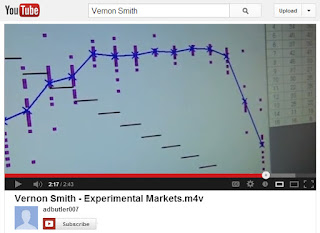
Screenshot image of YouTube's web page where the documentary describing some of Vernon Smith's experimental economics work is hosted.
Launch Bubble Experiment Video
Based on the studies that earned Vernon Smith his Nobel Price in economics, if you are human, you would be a creator of bubble. You would drive the price of an asset that will soon become worthless to a unsustainable level until it inevitably collapses.
Since the eighties, Mr. Smith has been conducting experiments that reliably created nice and frothy financial bubbles no matter who was behind the buy button. It seems that when you ask people to make money, everybody has it within themselves to be able to turn into an unmentionable, like a Wall Street banker or worse. I suggest that you check the short video describing one of these tests. Seeing Mr. Smith's experiments has changed my views about bubbles. I am convinced that we will continue to create them.
Right now, a bubble in bonds is ready to pop any day. But since almost no one understands bonds, it will probably be misrepresented. Bonds are the kind of economics stuff that makes people's eyes glace.
What will surely get lots of airtime are the effects from the blow up. Whether we know it or not, bonds affect everything. Interest rates and borrowing are tied to the bond markets. Bonds also affect cash-flowing assets like real estate and dividend paying stocks.
Photo of white balloon on black background. The balloon has a line drawing image of an asset price graph showing a boom and bust cycle
Bond Bubble
In a previous post, I covered the current state of the housing market and the many distortions taking place. Benjamin Graham, the father of value investing, once said "in the short term, the stock market behaves like a voting machine, but in the long term it acts like a weighing machine". This phrase too applies to the real estate market. In the short run, the market is distorted. The Fed's push for liquidity plus a surplus of global savings create a tidal wave of funds seeking a place to land. As the Federal Reserve's Quantitative Easing program crowds these funds out of Treasury Bonds, the inevitable result is that way too much risk-adverse capital is being deployed by companies like Blackstone to drive prices of the wrong type of assets. Assets that would be much more stable when fueled by patient capital from home buyers instead. Even builders have noticed the distortion. Lumber prices are way down, as a sign that things are not peachy on the housing supply side.
Real estate does not have to be in a bubble for home prices to come down sharply. As long as bond values collapse, real estate will correct to the point of long term balance. Even Robert Shiller, the greatest authority in real estate and the creator of the S&P Case-Shiller Index, has been warning that a real estate bottom has not been reached yet. He is clearly skeptical of the sustainability of the present rise in the housing index that he created.
Just 13 years ago, we saw the collapse of the Tech Bubble. Then, in 2008, we all played the game once again. We witnessed the implosion of the financial derivatives and real estate bubbles. To prevent these bubbles from happening, many have called for more government oversight and more regulations. Yet existing regulations proved inadequate. Meanwhile, bigger regulators and the structural rigidity from extensive regulations do create a lethargic-bureaucracy where progress is slow and innovation is absent.
Photo composition of small boat floating over the ocean with a piano and stool falling off the sky. There is the legend: "Murphy's Law" "If it can go Wrong, it will !"
Theory of Constraints
That regulations do not solve the problems should be readily understood by those with a basic knowledge of Eliyahu Goldratt's Theory of Constraints. Knowing with certainty that Murphy's Law will occur does not give any indication of where it will happen. Likewise, knowing that bubbles will happen does not mean that we know where to place the right regulation. A bubble will simply pop elsewhere. This is a fundamental fact known by operations experts all around the world. As a business manager, if you are not abreast of the wealth of knowledge that now forms the core of practices like Six Sigma and LEAN, you are absolutely and without a doubt doing a disservice to your company, family and society. The Toyota Way, which is part of what created this fantastic operations movement, has instituted effective methods to successfully deal with constraints of varying nature, such as those addressed by Mr. Goldratt.
Logo image of Regulations.gov, the government's wiki site where they intend to gain help from the people on new regulations to create.
Regulations-happy Nation
Incredibly, our politicians and the public seem to be perpetually engaged in a fruitless merry-go-round as they hold hope that regulations can be effective. Inexperienced warehouse managers fall on the same traps. Thankfully, the answers are ready and available to those who take the time to invest in a little bit of knowledge. Simply put, no amount of regulations will prevent constraints (or bubbles) from happening.
In conclusion, the evidence suggests that, like Murphy's Law, bubbles will happen. Perhaps it is time for the bond bubble to pop next. But Rather than placing blame, we should admit that bubbles are within us all. There is good scientific proof supporting this belief. We should also understanding that regulations will fail to prevent bubbles because of difficulties anticipating where to place such regulations. On the other hand, and since bubbles are created by incentives, we should look at incentives as a way to prevent bubbles. Maybe there is a lesson within operational practices at places like Toyota after all.


Monday, June 10, 2013

Backbone - Simply Performance

No matter what you think about your company, it conducts plenty of useless meetings, miscommunication costs it dearly every year and high potential employees are being bullied. I could go on.
Photo image of a business meeting where the executives seem much more interested in playing video games or playing pranks on sleeping coworkers.
It is said that, when the CEO of General Electric asks for coffee, one of his vice presidents will inevitably get him Brazil. Why? What does this mean? It means not that Brazil is for sale but that employees have a tendency to try to anticipate what the boss wants and often misread the signals. The fact that this is tolerated goes beyond my understanding. Better communication about what is wanted and about the unacceptability of such over reaction would go a long way in my opinion.
Moreover, because the company is the one paying for "Brazil", the employee would have no problem over reacting to the boss' wishes. What a waste.
The reality is that corporate waste runs rampant and that the problem is right under the leader's nose. This begs the questions: what would a company be like where people actually stood for what is right? What if people focused on what creates value rather than waste time on useless social exercises?
If you are a CEO, you want to answer these questions. You want to figure out how to get your people to act like professionals rather than children. Productivity and growth are at stake.
Beauty shot picture of Susan Marshall's great book "How to Grow a Backbone" "10 Strategies for Gaining Power and Influence at Work"
How to Grow a Backbone
Susan Marshall has made a career out of helping leaders answer these sort of questions and driving the right change. Her company, the Backbone Institute, makes transformational growth its target. Her book, How to Grow a Backbone, is a fantastic read that gives insight to the concepts behind the transformation.
From the title of the book, I got the impression that I would not learn much from the book since I clearly knew everything about having backbone. You will probably feel the same. I was wrong and so will you.
As I begun reading I wondered whether it was necessary for Susan to include the word backbone in almost every sentence. I thought that she was being overly simplistic. But as I worked through the book, she was able to take her style and paint the picture majestically. More important, it became evident that she was simply doing what every great CEO should do when an important subject is at hand: she talked about it and talked about it. Legendary CEO, Jack Welch, described how change had to be driven hard every day; that it had to be mentioned in every conversation time and time again. He would suggest that repetition had to continue well after we became tired of it. In the same fashion, Susan described the many ways in which a lack of backbone would cost the company. Every time, the concept was simple. Also every time, the importance was high. Do not be mislead by the simplicity. You must focus on the potential value to all.
Illustration of multiple repeating cycles over a bright yellow background and with the word "Repeat" above.
The company will benefit from employees with backbone. Employees will benefit from an increase of backbones through out the company. Employee families will benefit when each employee develops backbone. Everybody wins. As I said, the subject is very important to dismiss.
Now that if you are a leader who fears developing great professionals who express their mind, then this is not for you. You are already great! Here is Brazil.
There is simply no way I can do honor to Susan's work within this short post. As I read the book, she made me realize how many important employee traits were tied to the idea of a solid backbone. In a way, she has found the common denominator in performance. Yet, most impressive of all is that it is about something that most CEO's would immediately dismiss as being either soft or not material to their business. In my opinion, great professional performance is exponentially monetizable.
As the great leader that you are, plunge into the book. I will certainly refer to it plenty of times in future posts. Also look at Susan's services to evaluate what she could do for you. The risk associated with the exercise is minimal. The potential reward is stratospheric.

Book Title: How to Grow a Backbone
Book Subtitle: 10 Strategies for Gaining Power and Influence at Work
Author: Susan Marshall 
Publisher: McGraw-Hill
ISBN: 0809224941

Thursday, June 6, 2013

Price Increases - Targeting Just Past Nuisance

Upset your renters only to the point before they'd move.
This technique is what rental property owners view as the best way to increase the value of their assets. They use what's often referred to as the nuisance rental increase. Small increases in rental prices become a nuisance to renters but no more. As a result, occupancy remains the same while revenue increases substantially at the margin.
For businesses elsewhere, it is not as simple. Often, customers can walk away without having to bring in a U-haul. Price elasticity is much more difficult to anticipate. As a result, price increases risk damaging client relationships or even loss of share. Because sales teams are strong detractors of any corporate plan to increase selling prices, it is safe to assume that all companies struggle pushing inflation to their customers
Sepia photo image of a dike break due to floods.This is something that the Federal Reserve understands well. They take advantage of the fact that the market displays plenty of friction when trying to pass inflation from input to output. What this means is that businesses everywhere are the first to suffer when the economy experiences inflationary pressures. Because profits decrease one dollar for every dollar of cost increases, the associated damage to businesses is high. Yet, businesses still find it difficult to efficiently transfer inflation to their customers . 
The fact that raising prices is difficult makes it noteworthy when empirical evidence uncovers a wave of increases. Usually, businesses will hold until they can no longer sustain the pressure. Then, suddenly prices increase by quite a bit. This would be analogous to a dike break. 
I have observed costs at Costco increasing by a large percentage: in some cases over 10%. Costco is a great indicator of what the consumers will experience because they follow a strict policy of always marking all products exactly 10% above their cost. This means that any increases reflect actual cost changes at their vendors and not within Costco. So, price increases throughout the store result from price increases throughout their supplier network. As almost all important American consumer companies sell through Costco, their increases are quite responsive to market movements. Unlike Costco, most other companies retailing goods to consumers raise prices after a central decision at corporate, which masks market gyrations.
Photo image of the product isles inside of a Costco store.
Another sign of accelerating inflation comes from the transportation sector. Transportation affects the cost of all products. If you ever wonder how is it that there is a large difference between the cost of a coffee bean at the farmer and at the store, you probably get an idea of the costs of transportation contained within the products that you buy. Yes, Starbucks makes a good profit for themselves. Yet, transportation costs are a substantial part of the price of the final product.
I am aware that UPS, FedEx and pretty much all transportation companies charge an additional amount to cover fluctuations in fuel costs. Fuel surcharges were the response to fuel inflation and are directly driven by market changes. But these are not the cost increases I am referring to. Instead, I am addressing the actual transportation rates charged. While many companies pay a discounted version of the official rate, a 6% increase in this rate will still equate to a 6% increase in the discounted rate. So it is easy to see how much inflation customers are experiencing from simply looking at the notices from these shippers to their customers. 
Photo image of the many Procter & Gamble products sold at a typical supermarket in the US.
If only things like fuel went up, the important stuff, the Fed would simply hide it under the rug. They do it every month in the Core Inflation data they report. But when inflation finally becomes a businesses output across the broad market, no magic trick can hide it. I am seeing evidence of this exact thing happening. 
Am I being overzealous? Absolutely, I could be. Perhaps there is no need to start panicking yet. Just note that all discoveries are born from plain observation and that the increases I noticed were not trivial in magnitude; they certainly exceed the 3% long term inflation number.
These increases go past the nuisance level and should be considered. Paul Volcker, former Treasury Secretary, has highlighted that it is important to be aware of any changes in the inflationary environment because of the risks associated with high stimulus by central banks and the potential sudden break higher. The last thing that we need now is for businesses to face another round of profit erosion. Let's keep an eye on inflationary changes.

Wednesday, June 5, 2013

Now Available for Kindle Readers

For those on the go, this blog is now available for Kindle readers. Look for it at the Kindle Store.
Screenshot image of Amazon.com's web page where AlbertoALopez's blog is available for sale
Launch Kindle Store

Time: Costly Growth-Currency

Photo image of a sunken boat at a marina near the mountains.
A manager growing a business at the same rate as that of the industry is not growing anything. Credit can't be given for industry growth. Industries grow due to macro factors, like demographics, and not due to any single person. Paraphrasing President Kennedy: when the tide rises, even terrible ships go up. Yes, I butchered it. But it sends the right message. To measure real performance, take the company's growth rate and deduct the industry's rate. A positive number will mean expansion at the expense of competitors; which is a great thing.
As the residential boom gained steam after the turn of the century, many undeserving businesses thrived. Anyone could get a truck and a small crew to begin installing any of the many products going into the new mac-mansions. Success was almost guaranteed. Bad business models grew, leaving their managers with the impression that they had the magic touch. It is well known that success makes people think to be smarter than they really are. Growth accelerated and the party went on. Then, all of a sudden, the bottom fell off in April of 2006. The crews were fired and the trucks repossessed. Small business owners all over the nation were left wondering who took their success away.
What success? They just rode the wave until the wave crashed.
As a manager, you should always have a degree of skepticism about success. Take credit for what you have achieved but give credit where credit is due. If, for example, price inflation makes revenue go up, acknowledge that sales are up because of unit price increases. A quick count of units sold will usually reveal the truth. Likewise, mistakenly buying too much inventory right before the competition runs out of theirs is plain luck. I don't know about you, but I would rather be lucky than good. If the market gives me a freebie, I will take it and credit the market without a second thought.
Illustration over white background of a bar graph with ascending green bars and an upwardly tilted blue arrow.
Now that we have taken these extrinsic factors out of our growth chart, it would seem that there is not much left. Such is the impression that many small businesses have. While claiming to have a culture of aggressively driving growth, many companies really just sit still. Their managers are blinded to this fact. They thus feel no need to push for growth alternatives.
So, assuming that they would open their mind, how could they buy growth? Put simply: with resources. It costs time or money. Sometimes business intelligence helps get a discount; but for the most part growth must be payed with time, money or both.
A business that grows organically is paying for growth with time. In America, there are about a million companies with sales between one and four million dollars. A large portion of these has been in business for over 20 years. Often, their owners started with not much and grew their investment through lots of personal effort. No doubt that these owners have made a descent living as their business grew. But anyone who thinks that organic growth came at no cost should think twice.
To find the real value of time, just ask one of these business owners if she would do it again. Would she start from scratch again today? Would they spend another 20 years to duplicate what they have achieved? Chances are that they wouldn't. You see, time is viewed as free by young people who are just starting and seem to have a surplus of it. But as they grow older, time seems scarce and thus much more valuable. Building a business organically, it turns out, is a very expensive alternative.
Picture of a typical distribution warehouse
20 years ago, an entrepreneur without any idea of the cost of time started a business. Now, with the benefit of hindsight and experience, the same entrepreneur would not start the business again today. This point, I think, highlights why business owners who reach yearly sales between one and ten million dollars run out of steam. Companies everywhere struggle past this point in their life. I call this difficult time: corporate puberty, as it is a time when corporate identity comes into question. Intuitively, businesses just don't want to grow in the same way as they had, despite consciously claiming to be seeking growth.
The dichotomy of wanting-growth but really not-wanting-growth therefore originates from a lack of perspective. It simply has not occurred to these managers that they can buy growth with other currencies. Large businesses know this well. Small businesses are mostly blind.
Large businesses and their professionally trained managers know that acquiring other businesses is a good alternative to growing organically. It is well understood that, in general, it takes about five years for a business to expand into a new category and reach an adequate level of know-how. Sometimes, five years is simply too much to pay.
For example, a small businesses selling installation parts to small automotive repair shops may want to improve efficiency and gain additional business by adding delivery trucks. The problem is that efficiently and effectively running delivery trucks is not the same as just owning a company vehicle. There are correct and terrible ways to manage maintenance and routing concerns. There are also best practices on things like how to handle the associated changes to the balance sheet. Why not eliminate the risks and just buy a small delivery company? Even if the company presently serves a different industry, delivering cakes for example, the ideal acquisition target must have developed great expertise on operational efficiency.
From the outside, it would seem foolish for an installation parts business to buy a cake delivery business. But from the inside, it is a simple math calculation. At a low enough price, the cake delivery business could be acquired in lieu of having to pay years for the know how. If the acquiring company is large enough, the proportional cost of time increases while the proportional cost of money decreases. This means that money is discounted the larger the acquiring company is. This is because rapid deployment of the new service will give the acquiring company years of advantage over its competition; creating benefits that will be multiplied by the large number of customers. The gains could even offset the costs associated with shutting down the cake delivery business.
In this case, the right growth alternative was just a matter of thinking laterally and applying simple math. Likewise, sales growth could be acquired when hiring key industry people or by buying shelf space. Large retailers often sell the right to key locations to vendors willing to take the risk. For those who understand the benefits, there isn't even a question about the value of the space. But for companies without the experience, the idea of paying tens of thousands of dollars per moth for a single hook on a wall may be overwhelming. Unfortunately. many small businesses fall under this category. Their owners, as we described above, know no other way of growing but organically. To buy space as a way to buy business seems as high risk.
I know that there are plenty of businesses that fail to properly incorporate acquisitions. But if you think that growing organically comes on a straight line, you are mistaken. Both ways of growing have equally large pitfalls. There is a reason why it takes so much time for organic growth to take place.
Many will argue that acquisitions are more prone to internal silos and political infighting. But businesses that grew organically also display silos. The difference is that, because acquisitions don't cost much time, silos pop up quickly after each acquisition. On the other hand, silos take much more time to develop within organically grown companies because of the slow pace of growth. As a result, business anomalies like silos have nothing to do with the way a company grows but with management competence.
Most small businesses think that they have some sort of special culture and that bringing in a new group of employees will sicken their culture. To me, this is nonsense. A company that grows organically will also have to add just as many new employees from outside of the company. The problem is not the number of new employees. The problem is managing the rate of change. Organic growth grants more time for adjustments.
Some say that a new employee will not hold as much political power as a dozen new employees. This is true, although it again is a management competence concern. It is a matter of management rising to the challenge.
Unfortunately, management competence is where small companies fall short. Their management is generally not up to par when trying to properly handle these constraints. As a result, acquisitions don't create cultural breaks; poor managers do.
Line-drawing illustration of the balance between buying a business with money (acquisition) or with time (organic growth).
With capital at hand, I would chose to acquire another business by paying with money rather than paying for it with time. At least I can get to look for the right business features immediately rather than to have to wait a long time to find out. Who knows; things could change before we get to have success with the new organic venture.
Moreover, I see paying with time as being similar to writing a blank check. I much prefer to know that, even when things go off course, the cost will stay within a manageable range.
I suggest that you see growth as something than can be bought with time or money. I also wish for you to see that both time and money have a value. Specifically, don't discount time. Value it and preserve it.

Tuesday, June 4, 2013

State Capitalism - Unfair Market Competitor

After the undeniable failure of communism, do Russians finally believe in free markets? How about the Chinese? If so, how is it that China does not allow the Renminbi to float freely?
Photo of standing book by Ian Bremmer on white background. "The End of the Free Market" "Who Wins the War Between States and Corporations?"
The end of the free market
While there is no doubt that markets have helped China recover from leader Mao's programs like the Great Leap Forward and its subsequent social tragedies, free markets are still far from finding a homeland in China. Even the US, the global representative of all things good that come from free markets, isn't a free market economy either. See the many subsidies to the US cotton industry and their massive gravitational pull that distorts even global markets.
From totalitarian centrally-managed economies to the utopic free market, Ian Bremmer wrote a great book where he addresses these exact topics. The end of the free market focuses mainly on the effects and risks associated with state capitalism.
China, Russia and many other rising economies are now practitioners of this system, a mix between "free" free markets and central management; thus making state capitalism very important to all global market participants.
For a more in depth study of how state capitalism takes advantage of free markets for political reasons, read Mr. Bremmer's book. I found it to be quite fluid and insightful. The book will even clarify the reasons behind the new wave of anti-corporate leaders like President Obama.
I think that it is a must-read for anyone wishing to understand global markets as well as geopolitics.

Book Title: The End of the Free Market
Book Subtitle: Who Wins the War Between States and Corporations?
Author: Ian Bremmer
Publisher: Portfolio
ISBN: 9781591843016

Friday, May 31, 2013

Robust Real Estate Hides Truth

cartoon image in color of a small house
How great would it be to have lots of extra cash now that houses sell for much less than during the bubble? This is certainly the wish of millions of people looking to buy a house but struggling to get a loan. And now, to complicate things further, there are no more homes for sale. Things are clearly not as simple as offer versus demand.
The Pending Home Sales Index produced by the National Association of Realtors has hovered at a recent low due to insufficient inventories of homes available for sale. The glut of homes left after the bursting of the housing bubble seems gone. The few homes left are now going up in price due to aggressive bidding. As a result, the well respected S&P/Case-Shiller Home Price Index recently reported robust increases of more than 10% in year over year home prices. The natural conclusion to all these is that historically low interest rates have created a housing bounce.  
image of graph of CME's Lumber futures showing a sharp decline in the commodity
Lumber Future - Chicago Merchantile Exchange
Unfortunately, things don't look so great just below the surface. Lumber prices, for example, have collapsed since reaching a top at the end of last year. Whenever the housing marked is healthy, lumber goes up in price. This drop is an indication that construction has not recovered. Why wouldn't builders rush to construct more homes after selling prices and demand increased while competing inventories dropped? They clearly know something that the rest of us don't.
Meanwhile, real estate agents are seeing peculiar patterns in the market. Today, it is safe to be the highest bidder for a house. Once the winning bid is selected, everybody knows that appraisers will value the property much lower than the bid, dictating the actual selling price. After finding themselves in the middle of the housing bubble mess, appraisers are no longer willing to help drive pricing higher. To their detractors, appraisers are responding by being overly conservative with their valuations. As a result, winning bidders can eliminate competing bids before renegotiating a lower price that more closely approximates what the bank will lend. The bidding process is therefore irrelevant now.
Now that sellers know how to play the game too. They prefer to take a second or third highest bid if it comes from a cash buyer. Aside from eliminating low appraisal risks, sellers also protect against last minute loan denials, which seem to happen often. This means that high bidding cash buyers have the leading edge in this environment. 
illustration of a small house atop a pile of US cash
Hard Money
But these aren't the typical local cash buyer. The residential industry has long had a core local buyer: an investor who bids low and pays with so called hard money. Bidding high works against this type of investor because hard money costs too much in interests. To be profitable, he needs to bid low. He must also flip the homes quickly. Any delays reselling a house cost too much in interests. Notice that homes sold are not coming back to the market for resale and that winning bids are going up and not down. These local investors are therefore complaining that they are losing the bids to the few homes available. So who is devouring the homes for sale?
A recent conversation with a Palm Beach real estate investor shed light on the issue. "BlackRock is buying everything" he said after I asked who was buying all the homes. "And they are bidding high", he continued. BlackRock is a leading global investment manager best known for managing a few billion dollars of the Chinese sovereign fund. 
Every Wall Street hedge fund and money manager has been looking at all possible ways to take advantage of the state of the home market. Even Warren Buffet made repeated comments about loading up on homes if he could find a way to manage them. His comments reflect the fact that serious problems arise from holding residential properties within a portfolio. The market is quite fragmented; there are homes in every city in the nation. Yet, each home is different. Just buying all those homes is a logistics nightmare. Then there are the challenges of handling maintenance and payment collection. These has kept really big money out of each local market; until now. Rather than talking, BalckRock and a few others are acting.  
On May 29, CNBC's Squawk Box anchor Andrew Ross Sorkin asked BlackRock's CEO, Larry Fink, about the state of the economy. Among other comments by Mr. Fink, he said "we can't find enough good investments"; implying that they hold more money than what they are comfortable deploying. 
But how is it possible that there's so much capital available for money managers to buy all the residential inventory but there isn't enough for families to borrow to buy a home?
The reality is that BlackRock is not alone. There are massive pools of capital struggling to find assets where to invest. With low interest rates on treasuries and a Fed that continues to be a large treasury buyer, risk-adverse capital is being crowed out of typical investment vehicles. These funds are pushing dividend-paying low-risk stocks higher, for example. They also have depleted residential inventories.
cartoon image of a red blowing bomb, labeled "RISK"
Considering such large and homogeneous market participants, it should pay to know the risks associated with their involvement. First, there is the possibility that a change in macro-economic risk may increase fund redemptions at these firms, forcing their managers to dump properties at low prices. The real estate market would relapse; pushing many home owners further underwater and adding many more to the list.
Next, there is the question of exit strategy. When will all money managers get out of their investments and what if all exit at the same time? This unknown is probably what's forcing builders to think twice before fully firing up their engines once again. A large and sudden increase of new listings from exiting money managers as they take aim at the next hottest asset class could ruin builders who are caught flat footed.  
Then, there is the uncertainty of the returns. Despite great expertise within companies like BlackRock, there is the possibility that successfully managing properties at this scale may not result in the risk-adjusted profits they expect. In money management, there is always a question about being invested in the categories that have the highest yields. At some point, real estate property management will certainly fall below other asset categories forcing them to liquidate faster than would have been the case for local investors. 
Finally, there is the risk of exhaustion. There is the possibility that all or most of low priced properties have already be taken. Money managers have pushed prices higher, reducing the potential profits from the rest of the properties still in inventory. At the same time, prices are yet to be high enough for builders to construct new homes at profitable levels; thus limiting builders ability to drive the next leg up of the real estate recovery. 
In a nutshell, the recovery that we see in the real estate market should be approached cautiously. Purchases by families are not driving the apparent improvement. Construction of new homes is not responding either. Furthermore, the properties sold could suddenly comeback to the market, making it collapse once again. Until we see families buy sufficient homes at prices high enough to help builders remain profitable, any signs of recovery could be just a mirage.

Tuesday, May 28, 2013

Chief Command-And-Control Officer not needed

"Delegation is the art of second best", said the Dubai Sheikh being interviewed for Discovery Channel's Richest People Of The Middle East documentary.
He added that "no one can do it better than the person who founded it and created it and knows what he wants out of it". He was referring to his dream of hosting a Grand Prix in his homeland. He was rationalizing his need to control every detail of the event.
Dawn photo image of a Dubai Grand Prix car in front of the Burj Al Arab
Burj Al Arab
Did his highness mean to say that delegating the programming of broadcast equipment to engineers would be second best to him doing it? By any chance, did he also think that it would be best for him to drive every car in the race since other drivers were clearly not at his level?
This is an area of the world where political leaders spend half their day individually listening to dozens of citizen complains as a way to demonstrate that they are in touch with their people. I said dozens because a day does not allow for much more than that. How then could they ever expect to run a large institution, like a nation, if they are involved with every little detail?
In response to the comment that delegation results in "second best" performance, I would suggest to his highness that he needs to learn how to hire qualified people instead of the incompetents that he obviously surrounded himself with.
Now, I am well aware that Dubai and other Arab Emirates have created incredible urban icons, like the Burj Al Arab, and that those accomplishments were possible only because of the fantastic work of some of the best engineers and architects in the world. But what I wonder is whether the people leading these Emirates know this fact as well? Anyone who thinks that delegation renders lower results has certainly missed the incredible landmarks that are rising over there daily. Many of these leaders design their own homes to show that they are great designers. Why? With their money, I would rather hire Frank Gehry to design my house. There is no way that one of my designs could out-cool Gehry's.
image of Frank Gehry building
Architect Frank Gehry
Even our armed forces now know that generals can not get involved with every aspect of war. Modern military intelligence ensures that information and decisions flow in whichever direction is best. Field intelligence often responds to threats much more rapidly than would otherwise be possible the old fashion way. In the past, a command and control mindset meant that everything flowed from top leaders to bottom soldiers. Bottlenecks were created as everybody had to wait for leaders who were burdened with so many details that they had no time for important stuff.
But command and control problems were not limited to yesterday's military. These had spread throughout business too. As thousands of military leaders returned from World War II, they were asked for their service once again.
black and white image of World War II returning heroes being welcomed home in a parade.Burgeoning manufacturing companies hired these heroes as managers. After the global industrial complex was left in shambles because of the war, American industrial companies experienced historic success. At the same time, former generals, colonels and majors deployed the same command and control techniques learned while at war. As a result, the image of the business leader who screams orders, is perpetually busy and is emotionally detached became iconic. It created an ideal image for millions of aspiring managers to follow.
Thankfully, there is plenty of evidence that such larger-than-life characters aren't necessarily effective leaders. From the great Emotional Intelligence work by Daniel Goleman to Jim CollinsLevel 5 Leader, we know that leaders must be much more inclusive in order to successfully navigate against the competition. Jack Welch's personal adviser, Peter Drucker, quantified the rate of change in the importance of delegation. It turns out that forty years ago, only 10% of a scientists' work required help from other scientists. In the late nineties, this changed to more than 62%. Even the smartest people in the world have to communicate their vision to others and count on their assistance to reach success. The image of the solitary inventor who innovates by divine intervention is no longer valid. Modern scientists are social animals first.
old image of a typical command and control manager; the typical office asshole
Surviving Workplace Assholes
If a person feels to be sufficiently smart to accomplish her goals, then the goals are simply not ambitious enough. Leaders with great dreams depend on the synergistic work of brilliant and effective teams. As Jim Collins once wrote, "people are not your most important asset. The right people are". Yesterday's manager had to be brilliant because selecting great people for their team was not important. On the other hand, the manager of today is dead-on-arrival without having access to the best people in the industry.
Command and control blinds business leaders from the fact that it is incredibly valuable to hire people who are better or smarter than they are. This blindness is what makes business owners think that employees are incompetent and that leaders are the only people who can get things done.
And why do managers need the best people available? To delegate big and complex responsibilities. Today, leadership is no longer just about the leader. A leader will often have to follow guidance from subordinates who are more knowledgeable and capable on the subject at hand. In 360 degree leaderJohn Maxwell illustrates how important it is for mid level managers to lead upward as well as sideways. In order to accept orders from an employee, you must be a leader who's very comfortable in his own skin. Any emotional insecurity and the whole delegation thing will go out the window.
It is time to eradicate the obsolete and unproductive command and control system. Build the best team you can. Hire people who are much better than you. Dream big. Reach your goals.