Showing posts with label Turnaround. Show all posts

Thursday, January 2, 2014

Failure at the Top

What's the most common problem in a failing company? This is the question I am often asked. Who or what is at fault in a struggling business?
old image of a large industrial era business with hundreds of desks
Many assume that bad employees or products are the cause
My answer? The top!
In general, once you have worked with a few diverse groups of employees you'll probably also conclude that all have a fairly typical distributions consisting of a star or two, many average performers and one or two who seem to enjoy sabotaging everything. But since this mix is typical in all companies and since all companies perform at different levels, failure must be elsewhere.
Instead, management is generally at the core of the problems. Things like emotional insecurity and dysfunction, abusive tendencies, lack of leadership and outright incompetence are normal characteristics of those at the top of poor companies.
And this would make sense if we think that management's activities are leveraged through the rest of the company's team. A great manager's input would multiply into much larger outputs. Likewise, the inverse would be the case.
photo image of an office environment with an aggressive and upset manager approaching a desk with a computer
Poor leaders display low emotional intelligence
Bad managerial actions create environments with silos, where cannibalism increases the need for shelter and safety. The high degree of distrust prevents synergistic cooperation among team members. Distrust then engenders management's perception of the need to micro-manage employees. Bureaucracy becomes abundant.
In general, employees hate coming to work, have long forgotten about personal or corporate goals and have no time or energy to create value. Yes, this is exactly how a vicious cycle works. A participant's actions reinforce negative systemic outcomes. This repeats time and time again until things spiral out of control.
Unfortunately bad leadership also happens with previously successful managers. Often, markets are so frothy that even bad business practices are rewarded with higher profits; gains that end as soon as the tide turns. Just as the Peter Principle defines that employees will inevitable get promoted to their level of ineptitude, so will bosses.
A previously successful sales person gets promoted to manager and fails due to the lack of adequate skills and understanding. The company then loses a great sales person after he is fired. Even demotion works to eventually end his successful career at the company.
In the same fashion, success in previous environments do not necessarily qualify a leader for the next challenge. Then, since hubris usually appears after a few wins, the manager is rendered blind and incapable of understanding how to solve the new problems being faced. This new take on the Peter Principle focuses on managers rather than employees.
Blue and black image of mountain climbers demonstrating high trust.
Trust in business is paramount
What is the solution? In technical terms, all vicious cycles require an externality before reversal could happen. An externality is a new outside influence to the system. Applying the right amount of pressure and the correct types of externalities can in fact reverse things enough that a virtuous cycle replaces the vicious one.
But what is an externality in practice? Usually, I am; but you too could be one.
When I come into a company, like the recent factory I worked with, I face the need to quickly and forcefully apply an external force over the key fundamental factors that define the troubles. For example? I must quickly give confidence to all participants that the problem is solvable, and that the right knowledge to to so exists and is well understood.
Trust is essential in a vicious environment before anything else can happen. But do keep in mind that I am not talking about a cumbaya moment. I prefer to stay focused on the reality of the matter by making sure that there are no elephants in the room that have not been addressed. Trust is built through transparency and a commitment to progress in exchange of lots of commitment.
It is also important that the team gets a few immediate wins to start creating positive momentum. This will also show saboteurs that things are no longer safe for them; that the team is now moving positively. I usually do not have to fire bad elements. Peer pressure and group progress sends the best message. Bad players simply quit on their own. I just need to make sure that there's lots of transparency on everybody's actions. Good performers get plenty of team cheers. High-five opportunities increase. Destructive lagers find it uncomfortable and try to save face by leaving. They usually land "a great job" elsewhere.
Standards and peer accolades must remain high through out. If anyone does anything good, I tell the world. The point is to push, push, push in a positive direction, which is what being an externality is all about.
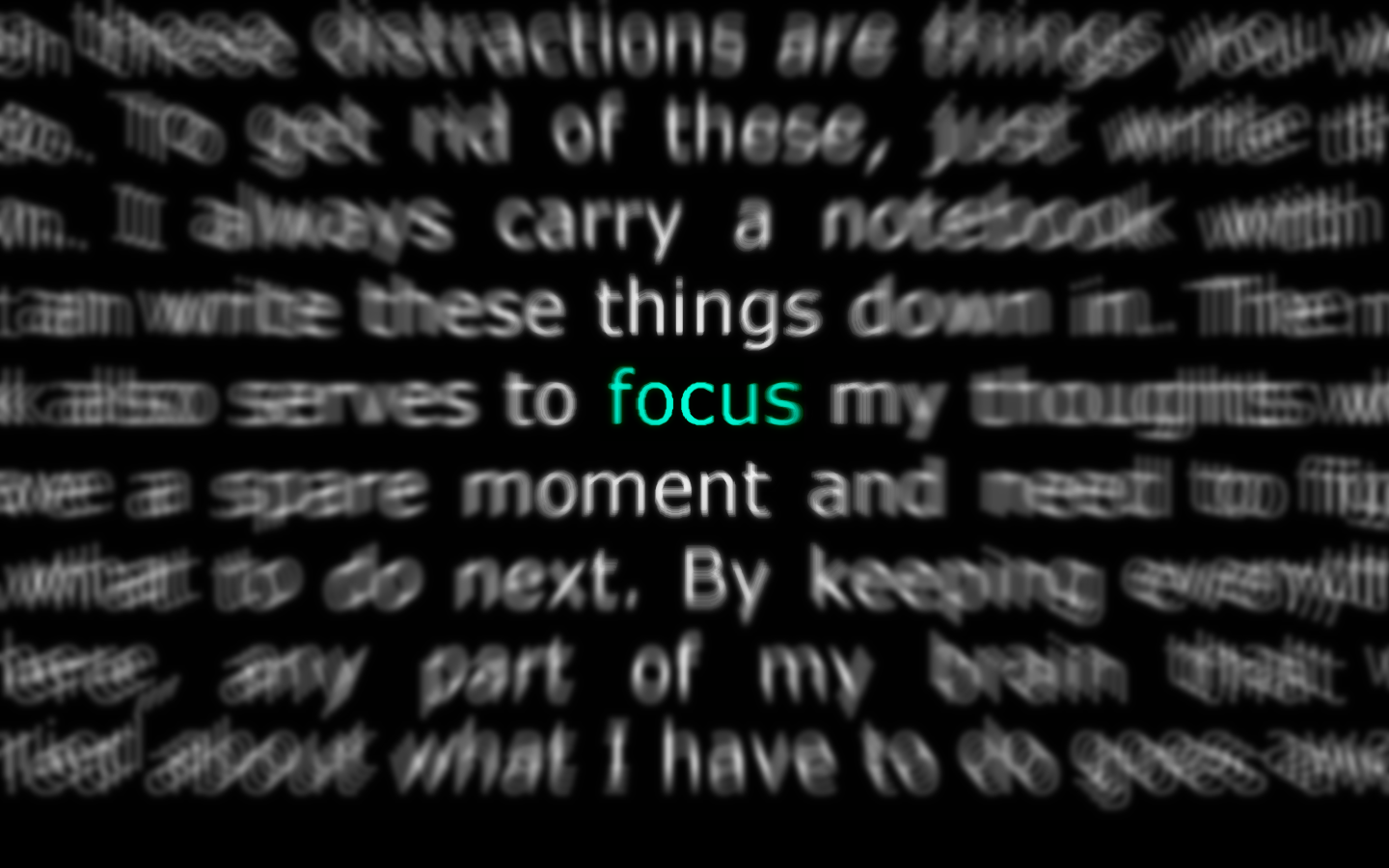
image of hundreds of words out of focus and the word "focus" in focus
Eliminate Distractions
I also remove distractions to save the energy that will be needed to achieve the new ambitiously high goals. As previously said, bureaucracy is high at these places. Bureaucracy creates friction to movement. So, I temporarily eliminate useless reports and meetings. This creates the sense of clear air around the office. It is paramount to use the new breathing room to push hard for what's important.
While structure is very good once a company has achieved maturity, it could slow down progress in a struggling company that must change to survive. What things? Well, at first it is never clear. The only obvious answer is that something must.
A study of the fundamental constraints to progress and a risk/reward analysis of possible solutions are key. Things that waste resources and offer low returns are then easy to de-emphasize, to put it politely. Hear the sound of sacred-cows falling everywhere.
Next, I begin to create personalized plans that align employee success with company progress. It is my experience that improving employee practices and skills at work also creates benefits to their personal life. So, make sure to help them see the connections between improvements in these two worlds.
photo image of Spain's soccer team as it wins the Euro-cup
In the best teams, everybody wins
This stage is about negotiating for mutual value. Once locating the important points, I must be the relentless couch who drives them to success. Personal progress must be measured often; not for punishment, as it is often used, but to show them how to gauge their good decisions. An important goal is to help employees learn how to independently operate in an upward direction.
As part of my job, I have to try to create a temporary gap between management and their team. I need at least a little separation and some time to improve things. As the source of the troubles, management is usually not very patient. I thus have little time and must act swiftly. Fast visible improvements are key. I must maintain a focus on positives and as much transparency as management can handle. It is not easy but it's what makes the challenge fun.
It goes without saying that costs must quickly be cut, that receivables collection must be accelerated and that supplier terms should be extended. While not a solution themselves, cash and cost improvements grant the time needed to solve things. They are thus very important.
Even when anyone can drive cash and cost improvements, those within the company usually struggle. This too must change. A revived team that has been conditioned to think in terms of cash flows will ensure that cash is never a problem again in the future.
graphical image in color of a few trends with one of them resembling a hockey stick. The image also has a hockey stick over the graph.
The only hockey-stick chart that works for me
is the one that looks back at factual data
At the end of the day, expect measured performance of the improved team to seem to come right out of a too-good-to-be-true presentation. You know, the same charts showing logarithmic improvements which inevitably raise suspicion.
I too do not believe in hockey-stick charts as a forecasting tool. But when they are used to report on verifiable performance, then I love them.
The best part of working with struggling companies is that I am left with many long term friends; people who have quantifiably outperformed all bench marks.
And how about their bad managers? Well, some get better jobs elsewhere. Others demonstrate that the Peter Principle does not negate improvement-after-failure. In fact, the creation of a virtuous cycle is so infectious that everyone. including management, comes on board.
There is just something fantastic about sharing a golden moment with all these fantastic people. I love doing turnarounds.


Update January 5, 2014
An expert in the matter, commented the following in an e-mail sent directly to me:

"The failure of a company is not always caused by "the top", at best only 65% of the time. The picture that you draw in your article is pretty heavy handed and very convoluted. It reminds me of an old saying, "it is not what you say, but how you say it." 
In my 33+ years as a retained search consultant, I have replaced many a CEO, and the first thing we do is a forensic analysis of what went wrong and why. As I mentioned earlier, failure from the top is only about 65% of the causal factor."

He is right! 
The problem with making any statement like mine is that it comes out as being absolute. And as he correctly observes, there are no absolutes in complex systems. 
My apologies!
I am nonetheless excited to see that his experience results in a close to 65% number. 
image of a chart comparing a typical and expected distribution with that of leadership failures in business
Failures at the Top
Typical Outcome Distribution
vs. those from 65% CEO/CFO/COO
and 50% CEO
If we apply a little statistical distribution modeling, we know that it is exceptional to see that such a small group of company employees (CEO's) account for such high number of failure events. Under normal distributions (I am geeking out here), the worst one percent (1%) of any group would be responsible for about 25% of failures. This comes from breaking down the curve of a common 80/20 distribution. 
So a 65% would certainly result from a curve with a very fat head and almost no tail. 
This is not an attempt at being cute. To find what is normal in business and what's not, I always try to look at how observed distributions compare to what would be expected under typical circumstances. In this case, while my implied message that 100% of business failures are due to failure at the top would be absolutely wrong, a 65% of failures coming from leadership would be equivalent to a catastrophic score card for the C-Suite. 
I therefore feel that my comments are statistically supported by the evidence gathered through this gentleman's long experience. 
My goal with my blog is not to just be heard but to open educational discussions, even if in the end it is proven that I am wrong. I thus feel that the value from this update lies on the way that one should benchmark things. 
I once met an executive who religiously followed an exhaustive hiring method. When I asked him how many of the chosen ones would go on to succeed at what was expected of them, he said 25%. 
Well, if I had a monkey flipping coins to decide who to hire, I would end with a random group. It could then be expected for the group to reach a success threshold around 20% of the time. In other words, his results were not much better than those from random luck. Needless to say, I was not impressed with his process, which I though was more of a pacifier than effective. 
On the other hand, one of his industry competitors achieved a 42% success rate hiring for the same positions. Now that was impressive. Any time that one can double expected results, the system is doing good work.
I appreciate the opportunity granted by this gentleman to address what I feel is a very important tool for management.

Wednesday, December 18, 2013

Great MIT Research - Free Access for a Limited Time

logo of MIT Sloan Executive Education
MIT Sloan
MIT is giving free access to a few of their incredibly valuable research papers to MIT Sloan Executives. It goes without saying that I feel that MIT is the absolute best school in the world. MIT researchers are the only ones that balance the art of business with the rigidity of data. I loved my marketing class because of this exact thing. As a result, their research is essential for all managers, from the middle to the top.
Make note of the fact that the availability is for a limited time. So hurry.
Below are the papers available. Otherwise follow the general link.


Articles by Deborah Ancona
Deborah Ancona is Professor of Organization Studies at MIT Sloan and Faculty Director of the MIT Leadership Center. She teaches in Transforming Your Leadership Strategy and the Advanced Management Program (AMP).
The Comparative Advantage of X-Teams

Articles by Erik Brynjolfsson
Erik Brynjolfsson is Professor of Information Technology and Director of The MIT Center for Digital Business. He teaches in Big Data 4Dx (online); Big Data: Making Complex Things Simpler; and Future of Manufacturing.
Winning the Race With Ever-Smarter Machines
Competing in the Age of Omnichannel Retailing
What the GDP Gets Wrong (Why Managers Should Care)

Articles by Steven Eppinger
Steven Eppinger is Professor of Management Science and Engineering Systems and Co-Director of the System Design and Management Program. He teaches in Managing Complex Technical Projectsand Systematic Innovation of Products, Processes, and Services.
How Sustainability Fuels Design Innovation

Articles by Tom Kochan
Tom Kochan is Professor of Work and Employment Research and Engineering Systems and Co-Director of MIT Sloan Institute for Work and Employment Research. He teaches in Strategies for Sustainable Business.
The Management Lessons of a Beleaguered Industry
Taking the High Road
MIT Executive MBA

Articles by Donald Lessard
Donald Lessard is Professor of Global Economics and Management and Professor of Engineering Systems. He teaches in Strategy in a Global World.
Building Your Company’s Capabilities Through Global Expansion

Articles by Fiona Murray
Fiona Murray is Associate Dean for Innovation. She is also Faculty Director of the Martin Trust Center for MIT Entrepreneurship. She teaches in the Entrepreneurship Development Program and the MIT Regional Entrepreneurship Acceleration Program (REAP).
Spurring Innovation Through Competitions

Articles by Alex Pentland
Alex ‘Sandy’ Pentland is the Toshiba Professor of Media Arts and Sciences, Director of Human Dynamics Lab, and Director of the MIT Media Lab Entrepreneurship Program. He teaches in Big Data 4Dx (online); Big Data: Making Complex Things Simpler; and Leading Change in Complex Organizations.
Understanding ‘Honest Signals’ in Business
Can High-Frequency Trading Drive the Stock Market Off a Cliff?

Articles by Douglas Ready
Douglas Ready is Senior Lecturer in Organization Effectiveness. He teaches in the new program,Building Game-Changing Organizations: Aligning Purpose, Performance, and People.
Enabling Bold Visions
Leading at the Enterprise Level
Why Leadership-Development Efforts Fail

Articles by Jeanne Ross
Jeanne Ross is Director and Principal Research Scientist at MIT Sloan’s Center for Information Systems Research (CISR). She teaches in Essential IT for Non-IT Executives and Revitalizing Your Digital Business Model.
Finding Value in the Information Explosion

Articles by José Santos
José F.P. dos Santos is Visiting Professor at MIT Sloan and Professor at INSEAD, Fontainebleau, France. He teaches in Strategy in a Global World.
Is Your Innovation Process Global?

Articles by Peter Senge
Peter Senge is Senior Lecturer in Leadership and Sustainability at MIT Sloan.
Collaborating for Systemic Change
Innovating Our Way to the Next Industrial Revolution

Articles by/featuring David Simchi-Levi
David Simchi-Levi is Professor of Engineering Systems at MIT. He teaches in Future of Manufacturing and Supply Chain Strategy and Management.
Is It Time to Rethink Your Manufacturing Strategy?
Your Next Supply Chain
When One Size Does Not Fit All

Articles by John Sterman
John Sterman is Professor of System Dynamics and Engineering Systems and Director of the MIT System Dynamics Group. He teaches in Business Dynamics: MIT's Approach to Diagnosing and Solving Complex Business Problems; Leading Change in Complex Organizations; Strategies for Sustainable Business; and Understanding and Solving Complex Business Problems.
What the Future May Bring

Articles by Scott Stern
Scott Stern is the School of Management Distinguished Professor and Chair of the Technological Innovation, Entrepreneurship, and Strategic Management Group at MIT Sloan. He teaches in theMIT Regional Entrepreneurship Acceleration Program (REAP).
Innovation: Location Matters

How Companies Can Avoid a
Midlife Crisis by Donald Sull
Articles by/featuring Donald Sull
Donald Sull is Senior Lecturer at MIT Sloan. He teaches in the new program, Building Game-Changing Organizations: Aligning Purpose, Performance, and People.
How Companies Can Avoid a Midlife Crisis
Closing the Gap Between Strategy and Execution
Using Commitments to Manage Across Units

Articles by Catherine Tucker
Catherine Tucker is the Mark Hyman Jr. Career Development Professor and Associate Professor of Marketing at MIT Sloan. She teaches in the Global Executive Academy; Strategic Marketing for the Technical Executive; Systematic Innovation of Products, Processes, and Services; and theEntrepreneurship Development Program.
Why Managing Consumer Privacy Can Be an Opportunity

Articles by/featuring Eric von Hippel
Eric von Hippel is Professor of Management of Innovation and Engineering Systems and the founder of the Entrepreneurship Program at MIT. He teaches in Building, Leading, and Sustaining the Innovative Organization and the Global Executive Academy.
The User Innovation Revolution
The Age of the Consumer-Innovator
Innovation by User Communities: Learning From Open-Source Software
Innovation Process Benefits: The Journey as Reward
The Benefits of Combining
Data With Empathy

Articles by Peter Weill
Peter Weill is Chairman of the Center for Information Systems Research (CISR) and MIT Sloan Senior Research Scientist. He teaches in Essential IT for Non-IT Executives and Revitalizing your Digital Business Model.
The Benefits of Combining Data With Empathy
The Business Models Investors Prefer

Articles by Peter Weill & Stephanie Woerner
Stephanie Woerner is Research Scientist at the MIT Sloan Center for Information Systems Research. She teaches in Revitalizing your Digital Business Model.
Optimizing Your Digital Business Model

Articles by Ezra Zuckerman
Ezra Zuckerman is Professor of Technological Innovation, Entrepreneurship, and Strategic Management and Chair of the MIT Sloan PhD Program. He teaches in Developing and Managing a Successful Technology and Product Strategy and the Advanced Management Program (AMP).
Improving Capabilities Through Industry Peer Networks

Friday, July 12, 2013

2013 Top 20 Business Books List (Part II)

Q&A Section
  • Question: Can you Recommend Any Good Business Books for Executives?
  • Answer: Absolutely (Part 2)! 
This is part two of my 2013 Top 20 Business Books List. If you missed the first installment, you may prefer to start there. In part one, I discussed ten books under the categories of Economics, the Environment, Human Resources, Leadership, Marketing and Operations. Today, we will end the list by going over the books on Strategy. Yes, half of the books in the list resided in just this one category. By using trader lingo, we could say that I am overweight Strategy.
Picture of Brown book over golden marble table with 2013 Top 20 Business Books List on cover
2013 Top 20 Business Books List
Why so many Strategy books? A reason could be that Strategy is important in business. Another more mundane reason may be that bookstores offer many more books dealing with Strategy than any other business subject; something I didn't test.
The real reason why my list is overweight Strategy is that it includes three series. There are three books by Clayton Christensen, three more by Peter Drucker and two additional ones by Jim Collins. Think of it this way: if each author was represented by a single book the total number of books under this section would be five; half as many.
While there is a high risk of repetition when suggesting various books from a single author, I did not make the choices lightly. Each book series was highly influential in my professional life. In all cases, every book was needed to get a complete message from the author.
Enjoy this the second part of my 2013 Top 20 Business Books List.


Strategy

Clayton Christensen
Beauty shot picture of book by Clayton Christensen, "The Innovator's Dilemma", "When New Technologies Cause Great Firms to Fail"
When New Technologies 
Cause Great Firms to Fail;
Clayton Christensen
We start with a trilogy that offers the latest in strategic thinking. Clayton Christensen, Professor of Business Administration at the Harvard Business School, created three fantastically insightful books. Each builds on the previous.
Thus, I suggest to start with The Innovator's Dilemma, then follow with The Innovator's Solution and end with Seeing What's Next. While each book offers new and independent ideas, they are all elegantly interconnected. Christensen's concepts are effective either way, in isolation or grouped together. It is this balance between individuality and unity that makes me think so highly of his books.
Through three three books, Christensen gives structure to a series of concepts; all tremendously important for business.
Beauty shot picture of book by Clayton Christensen and Michael Raynor, "The Innovator's Solution", "Creating and Sustaining Successful Growth"
Creating and Sustaining 
Successful Growth;
Clayton Christensen
Through his work, he suggests that strategic decisions made by businesses are binary in nature. There are just right or wrong choices. Right decisions propel the business far ahead of competitors and industry standards. Wrong decisions, on the other hand, hold the business back in mediocrity. The implied message is that all organizations continuously make the wrong choices.
His logical frame begins with an analysis of what happens when innovation disrupts an industry. How do market participants respond? What do market leaders do? What are the available alternative routes? What happens when each of such routes is selected?
Beauty shot picture of book by Clayton Christensen and Scott Anthony, "Seeing What's Next", "Using Theories of Innovation to Predict Industry Change
Using Theories of Innovation 
to Predict Industry Change;
Clayton Christensen
Next, he identifies and explains the common patterns he found. With superior insight, he disproves generally accepted business beliefs that will inevitably take a company to its perish. He breaks with tradition. From there, he studies the predictability of future performance based on corporate action.
Is your head spinning yet? Yes, all that I just wrote is quite cryptic. To me, everything makes sense. But to someone who has not read the books, these words probably sound like gibberish. If I am being a little ornery, it's because I want to make sure that you read these books and discover on your own. I don't want to give too much away.
From all that I have learned over the years, I have come across many neat techniques and ideas. But I found it almost impossible to discover new fundamentally based concepts. That's why these three may be the most important books I own today. In the future, as their prescriptions evolve from strategic advantages to best practices, there may be other more important books. But for now these three are the best in this list. As you read them, try to prevent the natural tendency to simply follow the text. Instead, I recommend that you stop periodically to make an inventory of what the book just described. Along that way, you will get the best from the them.
These three books are too valuable. As an executive, you can't afford not to read them. Start now.


Beauty shot picture of book by Peter Drucker, "Managing for the Future", "The 1990's and Beyond"
The 1990's and Beyond;
Peter Drucker
Born right after the turn of the 20th century, Peter Drucker had a front row seat to the nation's evolution from an aspiring and disorderly bunch, to leaders of the economic and military worlds.
From his great perspective, he was able to discern distinct macro patterns from the otherwise noisy global picture. Peter Drucker used insights from such patterns throughout his professional life. He became the most prodigious business thinker of the century.
The three books included here describes these patterns in an extensive fashion.
He notes, for example, that coal and the steam engine had a similar effect on the economy as today's computers. Coal and the steam engine gave birth to the locomotive. Likewise, computers gave birth to the internet. Both locomotives and the internet reduced distances and opened new markets. Just like locomotives created a global economic boom, so would the internet.
Beauty shot picture of book by Peter Drucker, "Managing in a Time of Great Change"
Managing in a Time 
of Great Change;
Peter Drucker
Early in his career, he recognized the impact that knowledge would have on productivity. Along the way, he coined the term knowledge worker. Later he would dedicate much of his effort to further develop his understanding of knowledge workers, the elements that drove their productivity and their emotional makeup.
Some have recognized Drucker as the father of modern business. During most of the first half of the 20th century, corporate managers studied law rather than business. At the time, there was no such thing as a business school.
Drucker has also been credited with applying strategy to business. Prior to such change, strategy was exclusively associated with war.
Beauty shot picture of book by Peter Drucker, "Managing in the Next Society"
Peter Drucker
As if these accolades weren't enough, Drucker was too the personal adviser to Jack Welch. Much of what Jack describes in his books were originally conceived during meetings between the two giants.
It should be evident by now that a collection of books that does not contain Drucker is simply incomplete. He has greatly impacted what we now know as business. He can't be missed.
It is incredible to think that his books are full of new and relevant ideas, even by today's standards. Just imagine how much of a revelation were his innovations 40 years ago.
Yes, there are a couple of repetitions within the three books. The idea of a knowledge worker, for example, is mentioned in all of the books. But Drucker is too important of an erudite for lazy research. Besides, each book covers a broad selection of different topics. So I had to include them all. I enjoyed these books greatly and so should you.


Jim Collins
Beauty shot picture of book by Jim Collins, "Good to Great", "Why Some Companies Make the Leap...and Others Don't"
Why Some Companies Make 
the Leap...and Others Don't;
Jim Collins
Everyone has a theory of what makes a good company. These beliefs are clearly visible in the way we conduct business.  But the reality is that no one really knows with a high degree of scientific certainty whether what they think is valuable or just voo-doo.
No one, that is, except Jim Collins. His first book, Good to Great, became a sensation precisely because it offered strong evidence that contradicted many widely held beliefs. Collins conducted an exhaustive study of public company data that lead him to many important conclusions. He framed these conclusions with the question: what makes a Good company become Great?
And that is how it all started. Collins applied regression analysis to determine how Good companies became much better than their peers. His first book documents the methodology he used and the results obtained.
Beauty shot picture of book by Jim Collins and Jerry Porras, "Built to Last", "Successful Habits of Visionary Companies"
Successful Habits of 
Visionary Companies;
Jim Collins
Very impressive is the fact that he was able to turn a scholarly document of such data-rich nature into a narrative that any manager could follow.
How do great companies set goals? What do they do or stop doing? What are the characteristics of their employees and leaders?
After dominating such a beast of a project, it occurred to Jim and his team that they should try to conquer an even greater challenge; their aim was to transcend time. They wanted to know what does it take to create a company that could outlast all other? Where there any special kind of founding principles? What about culture and practices? Was the leader's vision important?
I hope that by now you are excited with anticipation. The two books are fantastic and should be read in order, to get the most out of them. Jim is clear in his delivery. The ideas are all actionable on their own or as part of a complete restructuring effort. Best of all, his findings fit nicely with results from many other great researchers.
They are so good that you will want to share these books with everybody in your team.


Thomas Friedman
Thomas Friedman, multiple Pulitzer Prize winner for The New York Times, offers one of the most relevant geo-economic insights of our time.
Beauty shot picture of book by Thomas Friedman, "The World Is Flat", "A Brief History of the Twenty-First Century"
A Brief History of the 
Twenty-First Century;
Thomas Friedman
During one his many travels abroad, he noticed a pattern. The international playing field was beginning to level. The gaps in information, market transparency and access to resources between people in advanced nation, like the US, and those living in places like India begun to converge. It was this leveling that inspired the name of the book. The World is Flat describes how, for the first time and thanks to the internet and the digital age, people in faraway places are beginning to participate at a more equal level in our markets.
When I hear employees complain that the Chinese are taking their jobs, I reply that the Chinese are also fighting for my job. Even business owner's risk losing their job to business owners abroad. You see, the Chinese have a deeper commitment to becoming educated than most Americans. While we are trying to stop schools from giving homework to our children, Asians are often upset when homework is too easy or when there isn't science work for students to do at home. Now that many great colleges are offering free education online, it is a real shame that the only ones taking advantage of it are foreigners.
Then add the fact that Asians have a solid work ethic and you now can see the challenge. They are willing to learn more, work harder and get paid less. Even Steve Jobs once said that it was difficult for Americans to compete with the Chinese to make the iPhone. But the problem is not limited to factory workers and other forms of skilled labor. There is an incredible amount of new patents being created by Chinese divisions of companies like Microsoft. In no time, China will graduate more engineers than the US and the pressure on knowledge workers will increase. This should be a warning to doctors who think that they will always be able to charge as much as they want. Many X-ray charts are already being evaluated by experts in India overnight, for example.
A hungry and aggressive manager in China with such an educated and dedicated team, could easily push an American company into failure; ending all future-wealth dreams of the North American business owner.
For the first time, this book made me realize that we have now extended the major leagues to include additional and very competitive teams and players from abroad. Competition will therefore get tougher rather than easier.
The change is inevitable. We should stop complaining and start working faster and more effectively. It is time to stop the leisure that so many people in this country feel entitled to.
Always do remember that all these new comers don't want us to fail. They just want to drive the same BMW's. You will enjoy this book very much.


Kenneth Gronbach
Would you like to know what the future holds for your industry? How about any other industry? There is a method that renders a future economic forecasts of unbelievable accuracy.
Beauty shot picture of book by Kenneth Gronbach, "The Age Curve", "How to Profit from the Coming Demographic Storm"
How to Profit from the Coming 
Demographic Storm;
Kenneth Gronbach
Births are the only event that takes place in the past that can also offer a window into the future. While Harry Dent is perhaps the best known of the practitioners of demographic based analysis, it wasn't until Gronbach's book that I came across the concept. I therefore credit Gronbach with helping me understand it. The book is easy to read and his examples are clear and relevant.
Why did the number of Honda motorcycle dealers decline after Top GunThe movie hit theaters everywhere and created a great image for the products. Why did sales decline despite Honda's better engineering, better products and more competitive prices? Even the extensive marketing campaigns couldn't prevent revenue losses.
The reason behind this tragic business tail is that new wives do not approve of street rockets for their new husbands. Want to understand more? Read the book.
I will warn you that it'll be too easy to dismiss any ideas as being nice but unimportant for daily use. Bad managers keep their schedule busy by running from fire to fire. They are chaos experts. Like five-year-old's playing soccer, these leaders are data-dependent. They cluster together chasing the ball rather than running to where the ball will be. Like with soccer, it takes maturity to get a manager to see beyond the short term. This is why I believe that a great manager has the ability to compartmentalize short, medium and long term goals in a way that none is ignored. We should always keep an eye on all three of these periods regardless of the number of emergencies at hand.
The information contained in this book will fit nicely in the long term compartment. This is not because demographic-driven events never take place. No. It is because the long term eventually turns into medium and then short term. All demographic considerations thus transform from data into actionable strategy.

2013 Top 20 Business Books List
While it is difficult to recall every important fact in so many books, especially those I read over ten years ago, I aimed at creating a comprehensive list that could serve as a great informational foundation for any executive. Now that the list of complete, I hope that you find it relevant and valuable. 

Wednesday, July 10, 2013

2013 Top 20 Business Books List (Part I)

Q&A Section
  • Question: Can you Recommend Any Good Business Books for Executives?
  • Answer: Absolutely! 
Photo of black hard cover book with the phrase "2013 Top 20 Business Books" embossed on its cover
2013 Top 20 Business Books List
I will split it into two parts. Today, I will cover the first ten books.

Introduction
Many years ago, my grand father thought that the time had come to push my father, who was a teenager at the time, to read a real book. As a normal youngster, my father had many more important things to deal with than to read books. Tired of the pressure nonetheless, my father asked grandpa for a book to read. "I want to make sure that I read a good one", he said. To what my grand father replied, "how would you know it's good if you haven't read the bad ones?"
If I was to follow my grandfather's advice, I would have you read the good books as well as the bad ones. But just this time, it may be a good idea not to follow the wise-man's suggestion.
I have read over 250 books, most of which were business related. At an average speed, reading all of them should take about five months of solid dedication. Unfortunately, about half of them were a waste. From the rest, I consider 20 or 8% of the books to be fantastic.
As a way to benchmark the list, let's compare to Zappos' Library. Zappos, the online shoe retailer owned by Amazon, has 38 books as part of the library they offer to their employees. Zappos lets its employees take any of these books home any time they want. This is part of their seriously solid culture. I visited their offices and found their library to include the books I had read and many of the ones I am suggesting in this article. As someone who admires the company, I felt this was a great coincidence.
Photo of reading glasses over an open book. The subtitle reads "Lee un Buen Libro" in Spanish.
Lee un Buen Libro
But what if your top book is not on my list? Well, consider the fact that I have not read everything. Besides, it is always possible that I may be wrong.
In any case, you can still feel reassured that all the books on my list are serious contenders when compared to all other books, even if not absolute number-ones for each category.
A few of the books I am recommending are easy to read thanks to their narrative style. Books from authors Louis Gerstner and Jack Welch fall under this category. Then there are those that are densely packed with technical information. These may need to be read twice. But don't even think of skipping them. While harder to read, these contain incredibly innovative concepts. That is why they make it into the list. Paco Underhill's book and Clayton Christensen' fantastic trilogy fall under the latter more difficult category.
As a group, these books cover most topics within business; a coincidence that makes me feel good about the selection. From reading the blog you should know by now that I like to maintain broad business coverage.
The books are placed within various business categories to prevent having to rank unrelated books together. There are books on Economics, the Environment, Human Resources, Leadership, Marketing, Operations and Strategy.
Following are the first ten books from my 2013 Top 20 Business Books List. The second set of books will be available in a following post. Enjoy!


Economics
If you manage a business, you must understand economics. How else will you see the environment outside your window with the clarity needed to allow you to chart a successful plan? Let's also not forget that economics helps us understand how is it that people make buying and selling decisions; something of paramount importance.

Beauty shot picture of book by Tim Harford, "The Undercover Economist", "Exposing Why the Rich Are Rich, the Poor Are Poor-and Why You Can Never Buy a Decent Used Car!"
The Undercover Economist
Exposing Why the Rich Are Rich, the Poor Are Poor-and Why You Can Never Buy a Decent Used Car!
Tim Harford
I have read more books on economics than on any other subject. While many of them are easy to read and understand, these are often so basic that they feel repetitive; covering the same simple principles over and over.
Then, there are a few more that offer interesting new ideas but at a high access-cost to the reader. They are just hard to follow by those not intimately familiar with economics concepts and terminology. Because I felt that a general and clear understanding of the subject is preferable for typical executives, I stayed away from the latter; those books covering complex concepts. Instead. I opted for a book that could communicate with a high degree of clarity and relevance.
Tim Harford's book exceeded my threshold. It is simple to understand, broad in nature, focused when it matters and, at times, very funny; if there is such a thing as a funny economics book. It breaks the ideas discussed into easy-to-relate fragments. Why is it impossible to get a good used car? Read the book. You'll enjoy it. By not getting deep into the weeds, this is a book worthy of periodic recommendation.


Environment
Talking about the environment turns off many executives. But things are changing. While there was a time when employees were abused by their employers, today the best companies are those who treat employees with dignity.
I am not talking about feeding a sense of entitlement or giving in to value-eroding unions. Instead, I am referring to understanding that we are all members of a community that thrives when we all thrive. Game Theory tells us that to win big and often, everybody needs to give-in a little.
When we learn to honor our civil responsibility, by eliminating all harmful outputs, companies and citizens win. Notice that I didn't say we should protect this or that part of the environment. Making such statements inevitably leads to the kind of debates that derails the conversation away from the real issue. No harmful outputs is the goal instead.
This is not a matter of being a tree-huger or a regulation-lover; neither of which I am. In fact, I believe that regulations lead to wrong and unexpected outcomes; no matter how well intended such regulations may be.
In markets, greed is behind the creation of all of the value gained by every participant. That is what Adam Smith's invisible hand time-tested concepts suggest. Likewise, I feel that it is possible for greed to drive environmental responsibility. In other words, I believe that market forces, and not an over reaching government, lead to the right environmentally responsible solutions. It just takes leadership and confidence. The same stuff needed to treat employees with dignity. Note that this section may prove to be of greatest difficulty to many leaders.

Beauty shot picture of book by Ray Anderson, "Confessions of a Radical Industrialist", "How my company and I transformed our purpose, sparked innovation, and grew profits--by respecting the earth"
Confessions of a
Radical Industrialist
Confessions of a Radical Industrialist
How my company and I transformed our purpose, sparked innovation, and grew profits--by respecting the earth
Ray C. Anderson
Innovation is the best tool for business. At least from the point of view of economics, innovation is the only multiplier in the master productivity formula. To establish the size of a given economy, add labor and capital together and multiply the result by innovation. While labor and capital lead to linear growth, innovation leads to exponential expansion.
It is therefore essential that we deploy innovation to solve the challenge of creating businesses that are free from harmful outputs; as we have now defined our environmental responsibility. The target is for the same engineers that find better ways for business to profit to also devise creative solutions to the environmental challenge.
Interface Inc., lead by former CEO Ray Anderson, did exactly that. It didn't need regulations to become more responsible. Along the way, the company discovered that solutions that eliminat harmful outputs also improved company efficiency and subsequently raise profitability.
What would you do if you were trying to find the best way to transport a product from China to the US; at the lowest cost, fastest time, with the lowest risk of loss, and in the most customer-centric form? You would hire expert engineers to design everything: from packaging, to inner and outer cartons, to the best logistical route. Well, the environmental challenge is no different. You need engineers that will innovate for you. They will design changes that will eliminate waste and thus save you money. If you do it better than your competition, customers will be happier to spend more money with you. This is exactly what Interface Inc did. And Ray Anderson clearly describes every aspect of this process in his fantastic how-to guide for business leaders.
That Mr. Anderson was able to uniformly motivate so many professionals to solve environmental problems while increasing corporate profits shows his leadership ability. He empowered people to a higher goal.
At some point through the book, it will be clear that Anderson's environmental plans became a strong influence on President Obama's initial months in office. But don't let this turn you away from the book. Anderson accomplished incredible results by motivating and empowering others. In contrast, Obama uses fiat and dictatorship as part of a plan that has predictably failed to gained any traction. One was a competent leader while the other is not. Anderson obtained the results that Obama can't. The book is simply about doing things right and in no way endorses the incompetent White House resident.
Because it deals with an inevitable future where there will be less resources available, this book is a must-read for all leaders; especially those who use LEAN.


Human Resources
For Jack Welch, Human Resources was the most important side of business while at General Electric. This is, after all, the department that finds and develops the best employees the market can offer. HR establishes compensation, educates and gauges adherence to rules. As a result, this department can make or break your business.
What's interesting is that there aren't a lot of good books that deal with HR. It is as if legal compliance and insurance contracts were all that HR had to deal with. These facts make the following book even more valuable as it deals with the fundamental science behind human success instead.

Beauty shot picture of book by Daniel Goleman, "Emotional Intelligence", "Why It Can Matter More Than IQ"
Emotional Intelligence
Why It Can Matter More Than IQ
Daniel Goleman
I doubt that Daniel Goleman had the slightest idea that his research would become a cult. The term Emotional Intelligence has certainly taken over the business education industry.
While he wasn't the first to coin the term or even to discover that IQ (Intelligence Quotient) scores failed to have any correlation with human success in life, he did develop the subject to its point of critical mass. Thanks to him, Emotional Intelligence has now been democratized. We can all benefit from it.
Be prepared to read a highly technical book. It is, after all, a seriously scholar paper. This means that since you are not a psychologist, you will probably find much of the initial terminology a little dense. But be patient. Soon, you will be describing the Limbic System with the same degree of dexterity as any surgeon.
Today, every business school offers courses on Emotional Intelligence, the kind of intelligence that matters in the real world and which is the focus of this book. Look online and you will find countless Emotional Intelligence groups and certification programs. Regardless, this book is the only original.
Next to Emotional Profiling, Emotional Intelligence is the most important concept to master. Unfortunately, I have yet to come across a good book on Emotional Profiling. Thankfully, Emotional Intelligence is well covered here.
Understanding the book's concepts will also result in a much happier you. Not because this is a Kumbaya book, but because it clearly explains how you are and what can be done with what you have. This book is so good that it is often quoted by the best business writers.


Leadership
The books in this section are by far the easiest to read. Narratives seem to always resonate with people. Deep inside, we all like stories. But these are not just superficial stories. No endless Rich-Dad-Poor-Dad narratives where one is left wondering where the new insights were. No! These are documents full of the right stuff. They have as much essence as a Harvard Business School case study.

Beauty shot picture of book by Andrew Grove, "Only the Paranoid Survive", "How to Exploit the Crisis Points That Challenge Every Company"
Only the Paranoid Survive
How to Exploit the Crisis Points That Challenge Every Company
Andrew S. Grove
Only the Paranoid Survive is an incredible book. It narrates the difficulties endured by Intel on its way to becoming the company we now know. There was a time that things were so bad that Andy Grove, the author, faced the possibility of being fired. This prompted him to explore what would happen if he was fired and then re-hired for the same position? He asked, what would a recently hired Andy do with the problems? What would the changes be? Then, with his new insight, he executed. There were no sacred cows or pet projects left. This became a unique moment highlighting the importance of introspection; a point discussed in Emotional Intelligence.
The book addresses how Intel was reinvented after the company had to completely abandon what it did best in order to survive. Andy also discusses the interesting concept of 10x performance improvements.
After reading Only the Paranoid Survive, you will be left with the conviction that seeing way into the future is indeed possible when surrounded by capable people.

Beauty shot picture of book by Louis Gerstner, "Who Says Elephants Can't Dance?" "How I Turned Around IBM"
Who Says Elephants
Can't Dance?
Who Says Elephants Can't Dance?
How I Turned Around IBM
Louis V. Gerstner
I came across this book by accident. I found it on a bargain shelve at a TJ Maxx. You know, the kind of shelve where everything looks like garbage. It was quite a find, if there was ever one.
Since the book is old, you may have difficulty buying it. It is nonetheless worth the search.
Louis Gerstner came from McKinsey via American Express. Next to the Boston Consulting Group and Bing and Company, McKinsey is at the top of the business consulting world.
His ability to be both incisive and a clear thinker meant that he was born to solve complex problems; and it turns out that IBM had massive problems indeed. This book narrates his experience trying to break bureaucracy and lethargy at Big Blue. After his arrival, Wall Street analysts asked what his strategic plan was. He responded that IBM had lots of those in their file cabinets. Clearly, that statement took backbone.
Under Gerstner, IBM went from a capital-intensive electronics manufacturer to a high return-on-capital consulting firm. Profits and employee morale skyrocketed. It is perhaps the best reinvention of a company in the history of American capitalism. Gerstner prevented IBM from experiencing a Kodak moment. The book serves as a guide on how to successfully turnaround a business.

Beauty shot picture of book by Jack Welch, "Jack", "Straight from the Gut"
Jack
Jack
Straight from the Gut
Jack Welch, John A. Byrne
To many, Jack Welch is the best CEO of our time. Direct and unstoppable, this man was once known as Newton Jack. After taking the leader's chair at General Electric, he cut employees by such large numbers that it was said that only the buildings were left standing. He then started the turnaround. Under his control, GE became insanely profitable. Employees delivered much more value for him than for any other executive anywhere.
Jack introduced the idea of cutting the bottom 10% of employees to replace them with better people. His belief in education resulted in Crotonville, GE's Leadership Development Center where all promising stars are prepared to lead one of GE's many companies. Jack also took Six Sigma, Motorola's operational invention, to the ultimate level. By defining clear but demanding goals, Jack created a culture of performance never before seen in industry. If you like your job as a corporate leader, you will love this book.


Marketing
The art of creating demand for your products depends on your ability to understand your customers. The two books listed here are, without question, miles above any marketing theology books. Both rely on very solid research. They have proven to be effective under all circumstances.

Beauty shot picture of book by Paco Underhill, "Why We Buy", "The Science Of Shopping"
Why We Buy
Why We Buy
The Science Of Shopping
Paco Underhill
When it comes to Paco Underhill's work, I could go on and on dishing out accolades. I understood consumers and their shopping behavior only after reading this book. Before the book, I thought I knew something. After understanding Paco's work, I realized I was wrong. Chances are that you too will find much of what you're missing.
This book has tons of great information; so much so that it is like drinking water from a fire hose. No matter how thirsty you are, it is still a lot of information coming your way. I therefore recommend that you allocate enough time to fully digest the many great concepts Paco shares with his readers.
For a short insight into the solid work done by Paco and his army of researchers, read my previous post on this book.

Beauty shot picture of book by Clotaire Rapaille, "The Culture Code", "An Ingenious Way to Understand Why People Around the World Live and Buy as They Do"
The Culture Code
The Culture Code
An Ingenious Way to Understand Why People Around the World Live and Buy as They Do
Clotaire Rapaille
Do you know what's the difference between what Americans and the French think of cheese? American's view cheese as dead. It comes in a body bag. You keep it in the refrigerator. It's cleansed through pasteurization. The French, on the other hand, view their cheese as alive. It constantly evolves (grows more mold). It is kept outside the refrigerator. It's not pasteurized.
But the interesting question here is not about cheese. Instead, all value lies on the methods Clotaire Rapaille used to figure what we think about cheese. Think about it: we all know that consumers would never describe their food as dead, for example. This is what's most impressive about his work. He synthesizes research results until the solution is clear. What looks like a soft science after initial review, turns out to be very effective at deciphering what people want; all without asking them for a description. No need for the usually misleading focus group. Even Henry Ford commented that if he had asked customers for what they wished for during the developing the Model T, they would have asked for faster horses.
Mr. Rapaille's work and credibility are simply fantastic. He is on retainer with almost all the big companies in the US. His book is therefore a very important tool for anyone wishing to create strategic initiatives aimed at satisfying consumers.


Operations
What would you answer if I asked: what's the main goal of your operations department? I have asked this same question to dozens of operations managers and found the results to be quite disappointing.
The elimination of all waste! That's the goal. Time, labor, money and space are just a few forms of the resources that could be wasted. As a result, operations should engage with every aspect of business. Sadly, I have come across managers who think that operations are only responsible to supply desks and pens to employees. What a waste of opportunity.
Think about it. As a manager, you have two main responsibilities: to increase sales plus reduce costs. Operations deals with half of this equation. Yet, it is seldom taken seriously in business. Some managers think that being tough while negotiating with a vendor is all they can do to eliminate waste. Others think that counting toilet paper sheets delivers the goods. The problem with either is that they are treated as an art that only the manager is capable of doing, rather than a portable system that could be carried by all employees. They'll never become part of the company's culture and will have no chance at creating continuous improvements. To be of real value to the business, any waste-eliminating practice must be systemic. The books I selected send this message very clearly. They also show how important operations are for a business. Best of all, they do not get lost in the statistical jungle of LEAN and Six Sigma as many other books do.

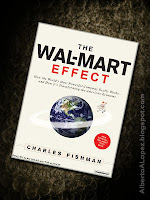
Beauty shot picture of book by Charles Fishman, "The Wal-Mart Effect", "How the World's Most Powerful Company Really Works—and How It's Transforming the American Economy"
The Wal-Mart Effect
The Wal-Mart Effect
How the World's Most Powerful Company Really Works—and How It's Transforming the American Economy
Charles Fishman
This book by Charles Fishman left me with a feeling of awe. It is clear that there is no company in the planet that is as equally committed to efficiency and the elimination of waste as Wal-Mart. They are, literally, vicious about savings.
Be prepared to read about how the company focuses on activities that would be viewed as trivial by competitors. From the way boxes are reused to the constant pressure they put on their vendors to reduce costs. Did you know that it was cheaper for Walmart to pickup products from Procter & Gamble than to have P&G ship them to Wal-Mart?
In their world, every fraction of a cent matters. There are just so many ready-to-use business practices within this book that it would be a terrible shame to skip it. The author does a great job keeping things objective. In today's Occupy Wall Street world, it would be easy to criticize Wal-Mart for their practices. But doing so would miss the institutional improvements that they have implemented for the benefit of their customers.

Beauty shot picture of book by James Womack and Daniel Jones "Lean Solutions", "How Companies and Customers Can Create Value and Wealth Together"
Lean Solutions
Lean Solutions
How Companies and Customers Can Create Value and Wealth Together
James P. Womack, Daniel I. Jones
This great book by James Womack, professor at the Massachusetts Institute of Technology, made me understand the true value of LEAN. It gave me a rare a-ha moment.
The book keeps the message clear from jargon or data. It is therefore accessible by every executive regardless of statistical-analysis experience.
LEAN focuses on the elimination of all non-value-add activities. But this phrase carries no meaning without context. You will need the explanations contained in this book.
Best of all, the book takes a manufacturing-centric idea and expands it to other business areas. When you read it, don't just follow the words. Instead, take everything the book describes and ask how it could be applied to your industry. LEAN is a great concept because it is naturally flexible and adaptable. It's therefore very possible that you may turn into an executive who gives LEAN new uses.

The Second Part
In my next post, I will tackle the rest of the books. As a matter of coincidence, the second part of my 2013 Top 20 Business Books List deals exclusively with Business Strategy.