Showing posts with label Operations. Show all posts

Monday, November 14, 2016

Applying for the Nation's Butler Job

These days, it's impossible to look around without seeing a depressed progressive (a misnomer). From angry Soros-funded public protesters, to the usual sad face at the local retail store. 
composite image of a participation trophy at left and 2016 elections protesters through the streets of New York City at right
No participation trophies for losers; a first for Millennials
In a way, it isn't difficult to understand why things seem so bleak for so many of these grown children. Being their first election, they're struggling to cope with the fact that there won't be participation trophies handed out for all the losers. This is an unfair catastrophy, if you ask them.
Then there is the fact that many have forgotten their civics classes that clearly covered our electoral system. The US is not a strict democracy. No, our elections operate through a proxy-type-of-democracy. Unfortunately for anyone complaining, the rules have been the same for pretty-much ever. So, history has proven that a winner of a popular vote (all votes counted) could actually lose to the winner of the electoral vote (the proxy-votes). So, nothing to see here people; MoveOn (pardon the Soros pun).
In my opinion, the whole thing is just noise. Sallie Krawcheck, a so called LinkedIn Influencer, recently wrote an article, A Letter to Young Women, in the Age of Trump, for the LinkedIn audience where she cried about how terrible things are for women after Trump's win. Aside from being a poorly written article, a sign of her desperation to get as much verbiage published at different media outlets, as quickly, as possible, her circular logic suggests that life is now impossible to explain to our young female citizens. Since I could not stand the hyperbolic fallacy, I wrote a response. This short comment clearly explains my feelings about not only the present civil discontent but about what being a president of a country is all about. So, I thought it a best to also share it with my great readers. I hope you enjoy it.


Reply to LinkedIn article A Letter to Young Women, in the Age of Trump
Can I get a progressive/liberal member card to call myself an Influencer like Sallie despite the lack of merit?
Sallie, I have two daughters and a wife. Yes, I am the only male at home. The first thing I taught all of them was to never whine and to fight harder than everyone else. In other words, to follow my example. While I could play the immigrant card, I refuse to do so. Instead, I prefer to earn my rewards. I can't stand the concept of awarding participation-trophies. 
Image of Green Party's 2016 candidate Jill SteinDifferent that your experience, I think this is a great time to learn. During the present elections, I made sure that my daughters understood their vulnerable nature when exposed to a corrupt media. From Facebook, to Reuters, to the BBC, to Univision, to the New York Times, all media decided to create a distorted world around the most corrupt woman in US politics. The media treated Clinton as the only choice for president for being the only female in the race, all while Jill Stein of the Green party observed. Yes, the media actively discriminated against a woman. What a double standard.
Interestingly, the media drunk so much of their own KoolAid that they reached a sustained state of inebriation. Consequently the hangover was brutal. I suggest that your feelings are a simple reflection of such binge. Rather than objectivity, the media promises fairness; as in re-arranging-the-chess-pieces fairness. I find that it is this so called fairness that, when consumed in large regurgitated amounts, is terrible to your health. 
Me, I prefer to digest my own raw and objective data. I don't like all the editorial hormones that the media injects. As a result, I can see that Trump is no saint, that the Clintons deserve an extended isolation vacation with all meals paid by our tax dollars, and that if we finally fix our country's balance sheet my daughter's future will be better. 
The president of the United States is not supposed to be a role model. The job calls exclusively for a person responsible for administering our home while being accountable to our family, 'we the people'. 
Picture of Trump and Anthony Senecal, Donald J Trump's 30 year butler
Donald Trump's butler of 30 years, Anthony Senecal
In other words, we are hiring a butler/housekeeper for the nation. If our butler/housekeeper overspends, mismanages resources, creates household divisions, etc. we can immediately fire him/her. I don't know about you, but I certainly wouldn't hope for the butler to become the role model for my daughters to emulate as they grow . I also don't think that the butler should come and tell me what to eat or how to love my children. 
I feel Trump will do a great job because he is tremendously eager to take on the butler job. While Hillary relaxed her campaign efforts, relying on her ability to blow through money and to cheat anyone in her path, Trump woke up earlier and went to bed later than everyone else. To me, this is a butler worth giving a chance. Remember, Trump is neither going to convert into my daughters dad nor my household's savior. He will just be the house's administrator. Nothing else needs to be explained to young women. I can assure you, my daughters understood the lesson very well.

Wednesday, December 18, 2013

Great MIT Research - Free Access for a Limited Time

logo of MIT Sloan Executive Education
MIT Sloan
MIT is giving free access to a few of their incredibly valuable research papers to MIT Sloan Executives. It goes without saying that I feel that MIT is the absolute best school in the world. MIT researchers are the only ones that balance the art of business with the rigidity of data. I loved my marketing class because of this exact thing. As a result, their research is essential for all managers, from the middle to the top.
Make note of the fact that the availability is for a limited time. So hurry.
Below are the papers available. Otherwise follow the general link.


Articles by Deborah Ancona
Deborah Ancona is Professor of Organization Studies at MIT Sloan and Faculty Director of the MIT Leadership Center. She teaches in Transforming Your Leadership Strategy and the Advanced Management Program (AMP).
The Comparative Advantage of X-Teams

Articles by Erik Brynjolfsson
Erik Brynjolfsson is Professor of Information Technology and Director of The MIT Center for Digital Business. He teaches in Big Data 4Dx (online); Big Data: Making Complex Things Simpler; and Future of Manufacturing.
Winning the Race With Ever-Smarter Machines
Competing in the Age of Omnichannel Retailing
What the GDP Gets Wrong (Why Managers Should Care)

Articles by Steven Eppinger
Steven Eppinger is Professor of Management Science and Engineering Systems and Co-Director of the System Design and Management Program. He teaches in Managing Complex Technical Projectsand Systematic Innovation of Products, Processes, and Services.
How Sustainability Fuels Design Innovation

Articles by Tom Kochan
Tom Kochan is Professor of Work and Employment Research and Engineering Systems and Co-Director of MIT Sloan Institute for Work and Employment Research. He teaches in Strategies for Sustainable Business.
The Management Lessons of a Beleaguered Industry
Taking the High Road
MIT Executive MBA

Articles by Donald Lessard
Donald Lessard is Professor of Global Economics and Management and Professor of Engineering Systems. He teaches in Strategy in a Global World.
Building Your Company’s Capabilities Through Global Expansion

Articles by Fiona Murray
Fiona Murray is Associate Dean for Innovation. She is also Faculty Director of the Martin Trust Center for MIT Entrepreneurship. She teaches in the Entrepreneurship Development Program and the MIT Regional Entrepreneurship Acceleration Program (REAP).
Spurring Innovation Through Competitions

Articles by Alex Pentland
Alex ‘Sandy’ Pentland is the Toshiba Professor of Media Arts and Sciences, Director of Human Dynamics Lab, and Director of the MIT Media Lab Entrepreneurship Program. He teaches in Big Data 4Dx (online); Big Data: Making Complex Things Simpler; and Leading Change in Complex Organizations.
Understanding ‘Honest Signals’ in Business
Can High-Frequency Trading Drive the Stock Market Off a Cliff?

Articles by Douglas Ready
Douglas Ready is Senior Lecturer in Organization Effectiveness. He teaches in the new program,Building Game-Changing Organizations: Aligning Purpose, Performance, and People.
Enabling Bold Visions
Leading at the Enterprise Level
Why Leadership-Development Efforts Fail

Articles by Jeanne Ross
Jeanne Ross is Director and Principal Research Scientist at MIT Sloan’s Center for Information Systems Research (CISR). She teaches in Essential IT for Non-IT Executives and Revitalizing Your Digital Business Model.
Finding Value in the Information Explosion

Articles by José Santos
José F.P. dos Santos is Visiting Professor at MIT Sloan and Professor at INSEAD, Fontainebleau, France. He teaches in Strategy in a Global World.
Is Your Innovation Process Global?

Articles by Peter Senge
Peter Senge is Senior Lecturer in Leadership and Sustainability at MIT Sloan.
Collaborating for Systemic Change
Innovating Our Way to the Next Industrial Revolution

Articles by/featuring David Simchi-Levi
David Simchi-Levi is Professor of Engineering Systems at MIT. He teaches in Future of Manufacturing and Supply Chain Strategy and Management.
Is It Time to Rethink Your Manufacturing Strategy?
Your Next Supply Chain
When One Size Does Not Fit All

Articles by John Sterman
John Sterman is Professor of System Dynamics and Engineering Systems and Director of the MIT System Dynamics Group. He teaches in Business Dynamics: MIT's Approach to Diagnosing and Solving Complex Business Problems; Leading Change in Complex Organizations; Strategies for Sustainable Business; and Understanding and Solving Complex Business Problems.
What the Future May Bring

Articles by Scott Stern
Scott Stern is the School of Management Distinguished Professor and Chair of the Technological Innovation, Entrepreneurship, and Strategic Management Group at MIT Sloan. He teaches in theMIT Regional Entrepreneurship Acceleration Program (REAP).
Innovation: Location Matters

How Companies Can Avoid a
Midlife Crisis by Donald Sull
Articles by/featuring Donald Sull
Donald Sull is Senior Lecturer at MIT Sloan. He teaches in the new program, Building Game-Changing Organizations: Aligning Purpose, Performance, and People.
How Companies Can Avoid a Midlife Crisis
Closing the Gap Between Strategy and Execution
Using Commitments to Manage Across Units

Articles by Catherine Tucker
Catherine Tucker is the Mark Hyman Jr. Career Development Professor and Associate Professor of Marketing at MIT Sloan. She teaches in the Global Executive Academy; Strategic Marketing for the Technical Executive; Systematic Innovation of Products, Processes, and Services; and theEntrepreneurship Development Program.
Why Managing Consumer Privacy Can Be an Opportunity

Articles by/featuring Eric von Hippel
Eric von Hippel is Professor of Management of Innovation and Engineering Systems and the founder of the Entrepreneurship Program at MIT. He teaches in Building, Leading, and Sustaining the Innovative Organization and the Global Executive Academy.
The User Innovation Revolution
The Age of the Consumer-Innovator
Innovation by User Communities: Learning From Open-Source Software
Innovation Process Benefits: The Journey as Reward
The Benefits of Combining
Data With Empathy

Articles by Peter Weill
Peter Weill is Chairman of the Center for Information Systems Research (CISR) and MIT Sloan Senior Research Scientist. He teaches in Essential IT for Non-IT Executives and Revitalizing your Digital Business Model.
The Benefits of Combining Data With Empathy
The Business Models Investors Prefer

Articles by Peter Weill & Stephanie Woerner
Stephanie Woerner is Research Scientist at the MIT Sloan Center for Information Systems Research. She teaches in Revitalizing your Digital Business Model.
Optimizing Your Digital Business Model

Articles by Ezra Zuckerman
Ezra Zuckerman is Professor of Technological Innovation, Entrepreneurship, and Strategic Management and Chair of the MIT Sloan PhD Program. He teaches in Developing and Managing a Successful Technology and Product Strategy and the Advanced Management Program (AMP).
Improving Capabilities Through Industry Peer Networks

Sunday, August 4, 2013

The Tragic Story of a Great In-N-Out Burger

Photo of IN-N-OUT BURGER's outdoor sign as visible from a highway exit
The Sign
IF YOU HAVEN'T ALREADY, TRY AN IN-N-OUT BURGER ASAP. YOU WILL LOVE IT. Unfortunately, In-N-Out Burger, the book by Stacy Perman, is not quite as tasty.
I very much looked forward to reading about this company. As the purveyors of fantastic and savory burgers, I was hoping to find a few great lessons from the narrative of the business story behind the company. Instead, I found a terrible tail that started with laborious stubbornness and ended with pure greed. I was probably better off not finding out.
While the big fast food names were being built, In-N-Out Burger refused to grow. The author claims that this was due to some ethereal commitment to quality. To someone like myself, a professional who believes that growth from such minuscule market share does not have to be tainted by poor quality, it looks as if the founders were incompetent at managing their dilemma. After all, today they are much bigger than they originally were; all while still keeping product quality robust. The same could have been achieved much sooner, had they been either more ambitious or smarter. After all, they were neither the first, nor the last managers to face a growth constraint.
I am not saying that, as a society, we need another large fast food restaurant. What I am saying is that we need one of much better quality than the others. In a way, In-N-Out Burger let their fans down due to poor leadership.
beauty shot of the In-N-Out Burger Book by author Stacey Perman
In-N-Out Burger by Stacy Perman
The author also demonstrated her lack of business acumen as she tried to hype the company's story. At one point, Stacy Perman clarified that founder Harry Snyder was a micromanager before anyone knew what the word meant. Just a few paragraphs later, she described how he too was great at empowering employees. Unfortunately, this is not what micromanagers do. By using the micromanager description she was attempting to depict a leader with passion and confidence. But such managers micromanage because they second guess everybody else's decisions. They feel to be the only ones who have any sort of knowledge or understanding of business. Thus, employees end up having to double check every decision they make to safeguard their head. Rather than being empowered, these employees are terrified by a larger than life tyrant; which is not uncommon in family owned businesses.
At another point of the narration, the author tries to suggest that the company had a culture of hard work and simplicity which were reflected in the stores. Yet, Rich Snyder, the founder's son and company president after 1976, turned their headquarters into an overstated expression of luxury. Sorry but there was no Wal-Mart story of austere headquarters here.
Photo of a DoubleDouble In-N-Out Burger over the company's red serving tray and next to french fries
A DoubleDouble
Finally, the book fails by getting stuck with the usual platitudes about what's generally claimed as the essential ingredients that make a business good.
While it is a great recollection of the beginning of Californian suburbia and the start of those American icons like the NHRA and the many fast food restaurants from the time, it is of very little added value to any business leader.
Besides, even the author struggled to match the tragic family infighting lead by Burger Princes Lynsi Torres that occurred at the end of the book with the rosy picture she was portraying at the beginning. This was not a good business book. Stick to their burgers.

Book Title: In-N-Out Burger
Book Subtitle: A Behind-the-Counter Look at the Fast-Food Chain That Breaks All the Rules
Author: Stacy Perman
Publisher: HarperBusiness
ISBN: 978-0061346729

Tuesday, July 16, 2013

How Much Do You Buy? - US Retail Sales Report

Photo of six shopping bags on the floor and surrouding the legs of a lady shopper on hills
What do you do? 
This is the questions that's most commonly asked in the US to define an individual we just met. We seem to believe that a person's profession tells us who someone is. But while this may work from a social perspective, to understand a person's impact on the economy the right question should be: How much do you buy?
The US consumer is the envy of many nations. China, for one, would like to own many of them. But governments aren't the only ones with power-shopping in mind.
Visiting foreigners rush to outlet malls and premium retailers as soon as they land. When my mother-in-law visits us from south America, the local Chico's celebrates. They exclusively open the store after hours for her. She is then allowed to shop at her leisure and with a personal assistant. Would you believe me if I told you that she is not wealthy? She just loves shopping in the US.
In a very important way, shoppers define the economy. When consumers change buying habits, industries surge while others fail. This is the reason why every retailer has an eye on whatever Baby Boomers will do next. Boomers have made brands like Harley Davidson believe that they were "really good" at selling stuff. Honda thought the same with their street rockets during the late 70's and early 80's; that was at least until Boomers got married and stopped buying their motorcycles cold turkey. Hundreds of Honda dealerships closed. We will see what happens to Harley Davidson after aging lawyers discover that they won't be able to walk for days after ridding their hog for a couple of hours. It's incredible how small things like these impact the macro-picture.

Cyber-Push - Online Stores
Data Graph of Online Sales' Market Share of total sales and Year over Year Market Share Change in the US as of June 2013
e-tailers Market Share
and YoY Share Growth
If you ask a local brick and mortar retailer, they will probably tell you that online retailers have stolen a large portion of their sales; perhaps upwards of 45%. Because more consumers have adopted showrooming, retailers face the challenge of constantly having to defend their pricing decisions to a growing number of customers. In fact, it wouldn't surprise me if more than 45% of customers use online pricing as a way to put pressure on local retailers.
In contrast, the evidence shows that online retailers account for a much smaller share of total sales than brick and mortar retailers estimate.
As of today, the total market share for online sales resides right below 9%. This number is a vast improvement when compared to the close to 5% from the end of 2001.
Data Graph of Retail Sales for Nonstore (online) Retailers from January 2000 to June 2013
Retail Sales
January 2000 - June 2013
Nonstore Retailers
It is important to note that the late Peter Drucker doubted that online sales' would exceed the peak market-share of less than 28% by mail-order businesses.
Even if this prescribed maximum range proves to be a robust glass ceiling, there is still plenty of growth ahead for online retailers.
The updated sales chart for Nonstore (online) Retailers shows that, besides a clear and continuous rise, sales are actually accelerating. The old trend channel has now been left behind in favor of the new upper channel. If category growth continues, which it certainly looks like it could, more overhead channel breaks are possible. This means that a reversion to the bottom channel is highly improbable in the near future. Momentum is simple too strong; especially when compared to all other retail categories. 

The Lesser Side of Change - Department Stores
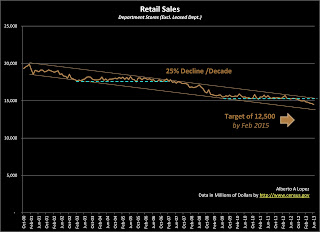
Data Graph of Retail Sales for Department Stores (Excluding Leased Departments) from January 2000 to June 2013
Retail Sales
January 2000 - June 2013
Department Stores (Excluding Leased Departments)
While online retailers continue their push higher, Department Stores have recently confirmed a new leg down within their negatively sloped trend. Since the turn of the millennium, more than 25% of their revenues have evaporated. That this is happening while population continues to grow highlights their terrible predicament. Boomers are slowing their support while younger shoppers are not coming on board. 
It seems as if the decline has not been kind with all retailers equally. Some, like Macy's have fared much better than others, like JC Penney. 
If the downward trend continues, it will be important to recognize that even the best management teams in the industry will struggle to keep their company growing. Great markets make bad managers look great while bad markets make great managers look bad. 
While nothing moves in a straight line, I feel that a reasonable target would be for total category sales to fall to near $12,500 million by February of 2015. Again, not a pretty picture.

Pent Up Expectations - Motor Vehicle Dealers
Data Graph of Retail Sales for Motor Vehicle and Parts Dealers from January 2000 to June 2013
Retail Sales
January 2000 - June 2013
Motor Vehicle and Parts Dealers
The nation is abuzz with the idea that automotive sales have rebounded. After all, who doesn't want Detroit, a symbol of our industrial might, to come back from its near death experience.
Fortunately, Motor Vehicle sales growth has built enough momentum now that it's trying to break above the Employee Pricing Program peak of 2005. Much of the push is probably due to the pent up demand accumulated during the past few years.
Unfortunately, a portion of the stored demand will be inevitably lost. This is because pent up demand has an expiration date. When a consumer skips two years to replace an aging car, she will not necessarily buy a vehicle two years ahead of schedule in the future to compensate. As a result, I feel that the chart to the right will not revert to its long term trend; which shows too large of a gap, even for any strong gains arising from further population growth. Moreover, there is a high possibility that we may experience a near-term correction in the trend as exponential-looking charts like this one are unsustainable.

What Inflation? - Gasoline Stations
Data Graph of Retail Sales for Gasoline Stations from January 2000 to June 2013
Retail Sales
January 2000 - June 2013
Gasoline Stations
Despite an unwavering commitment by our government to argue that inflation is nonexistent, Gas Station sales seem to paint a different picture.
As it's common with strong trending markets, the recent temporary boom and bust periods did not break the long term trend.
This trend should persist. Global inflationary pressure on energy costs and refinery bandwidth should continue for a few more decades while new middle classes are formed all around the world.
The chart shows that sales have just reached their 2008 peak. The coil formation shows that this is a pivotal point. When these coils form, charts usually move violently in either upward or downward direction. The fact that sales are now touching the bottom of the long term trend channel suggests to me that the coiling process is near its end. If this observation is correct, then sales could break either way any moment now.
Since energy consumption will continue to expand globally, even through slow economic stages, I expect energy prices to increase in the near future. This would drive Gasoline revenues higher. As a result, my bet is that the pivotal point that we are witnessing will resolve with a strong push upward, even if our national economy was to slow down. Hang on to your wallets.

Boom Anew? - Building Materials, Garden and Furniture
Data Graph of Retail Sales for Building Materials, Garden Equipment and Supply Dealers from January 2000 to June 2013
Retail Sales
January 2000 - June 2013
Building Materials, Garden Equipment & Supply Dealers
Despite evidence that housing continues to recover; I am skeptical that real estate investors like BlackRock will display the endurance needed for true long-term home-price sustainability.
Not withstanding any concerns I may have, retail sales at Building Materials, Garden Equipment and Supply Dealers have continued their recovery. Not quite past the 2008 peak, the chart shows its strong regression-to-the-mean tendency. Sales are close to the long term trend.
There are many reasons why these retailers should continue to rise despite a flat housing market. Home refurbishing could be as much of a driver as new home decoration, for example. At least for now, I feel comfortable assuming that sales at these retailers will continue to grow. If anything, I may keep an eye on the slope of the rising chart. I would not be surprised if growth was to decelerate in the event of lesser total US economic growth.
Data Graph of Retail Sales for Furniture and Home Furnishing Stores from January 2000 to June 2013
Retail Sales
January 2000 - June 2013
Furniture and Home Furnishing Stores
Also not surprising is the fact that Furniture and Home Furnishing stores are at approximately the same stage in their recovery. Both, after all, are levered to housing. The only note here is that it seems as if Furniture Stores will face a greater challenge than Building Material Stores trying to retake the long term channel.
It will be worth watching inventory levels and financial leverage of any retailers within these two categories. Those with the highest exposure to risk may fail in a continuously struggling environment. This is also a time when increased operational efficiency will result in improved market positioning.


Youthful Cheer - Sporting Goods, Hobby, Books and Music Stores
Data Graph of Retail Sales for Sporting Goods, Hobby, Books and Music Stores from January 2000 to June 2013
Retail Sales
January 2000 - June 2013
Sporting Goods, Hobby, Books and Music Stores
Sporting Goods, Hobby, Books and Music Stores are well within their long term trend. This category has proven to be quite resilient through the tough times; an indication that young shoppers have successfully taken the driver's seat from their Boomer parents.
Recently, the pre-recession top was confidently cleared. Growth will probably continue at the present measured rate. I just don't see a reason why growth should accelerate.
Now that innovation could completely change the picture. Let's keep an eye of these retailers to see if they surprise us


Old Faithful  - Grocery, Food and Beverages
Data Graph of Retail Sales for Grocery Stores from January 2000 to June 2013
Retail Sales
January 2000 - June 2013
Grocery Stores
At Yellowstone National Park, there is a famous geyser. Old Faithful never fails to deliver its gushes of steam and water, no matter the time of the year or the weather.
Likewise, there are those retailers that seem to always create positive cash flows during good and bad economic times. Grocery Stores, Food Stores, Beverage Stores, Food Services and Drinking Places are always reliable. They have in common that they serve a most basic human need: nourishment.
The three charts shown here display well controlled increases in sales over the long term. The trend channels are indeed smooth and tight. When it comes to Food and Beverage stores, not much changes over time; even during extreme boom and bust cycle gyrations. Looking at the three charts, it is difficult to discern any negative effects due to the global financial crisis. At most, sales flattened for a few months before continuing growth again.
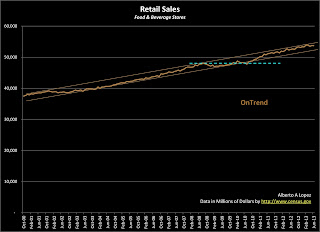
Data Graph of Retail Sales for Food and Beverage Stores from January 2000 to June 2013
Retail Sales
January 2000 - June 2013
Food and Beverage Stores
Also a sign of their tendency to perform, the 2008 pre-recessionary peak was easily surpassed by mid 2010 in all three charts.
A lot of discussions have taken place about the fact that during the recession many consumers stopped eating at mid to premium restaurants in favor of cheaper alternatives. While this may be the case at some level, the last chart (Food Services and Drinking Places) shows that overall sales did not change much. Maybe consumers changed from say a Chilli's to a Burger King; but the size of the bills did not change much based on what the chart shows. This, by the way, is not unusual when looking at large data samples. While many shifts at the micro level create quite a bit of noise, the macro picture has a mechanism that cancels out such noises.
Data Graph of Retail Sales for Food Services and Drinking Places from January 2000 to June 2013
Retail Sales
January 2000 - June 2013
Food Services and Drinking Places
As long as population continues to expand, I see no reason for any changes in behavior in these category charts.
The forecast is that we will see smooth growth for a few more years. Even if the economy was to slow down, Food sellers would at worse see a flattening in sales for a few months. Growth would return soon after.


Teenage Lifestyle - Clothing and Clothing Accessories Stores
Data Graph of Retail Sales for Clothing and Clothing Accessories Stores from January 2000 to June 2013
Retail Sales
January 2000 - June 2013
Clothing and Clothing Accessories Stores
There are many expenditures that parents can curve when trying to stay on a budget. Nonetheless, nothing is as hard for them as to say no to a relentless teenager who periodically hijacks their emotions with threats of clinical depression for not having the latest pair of jeans that "the other kids in school" wear. Yes, teenagers know how to play the spending game.
Clothing retailers also know how to press those bright and cheerful buttons. As a result, the Clothing and Clothing Accessories Stores category shows no sign of anything but continuous growth. The recession brought a slowdown in sales; something that by now is simply part of history. The category broke past the 2008 top with plenty of conviction. If anything, maybe the chart shows that we are close to a short term top that may be followed by temporary flattening or even a small pull back in sales. This would only happen if the US economy was to go into another recession. But from the demographic perspective, there is nothing on the horizon that could adversely affect this category.

Deflation Du jour  - Electronics and Appliances Stores
Data Graph of Retail Sales for Electronics and Appliance Stores from January 2000 to June 2013
Retail Sales
January 2000 - June 2013
Electronics and Appliance Stores
The electronics industry is perhaps the best supporting example of the belief that says that aggressive market competition is great for consumers, who are left with all the gains, while being terrible in the long term for the businesses that compete.
As technologies evolve, more complex manufacturing processes are compressed into tinier development times. This means that lagging competing products of good enough quality arrive to markets soon after those from the most innovating companies. Besides driving revenues lower, deflationary pressures are exerted much sooner than at any other time in history.
Then add the fact that online retailers have brought improved operational efficiency and pricing transparency to the market and you have a compounded deflationary effect. 
As a result, a store that sells the same quantity of units year-over-year will see a substantial reduction in sales and margins. In electronics, the only way to keep the head above water is by moving more boxes every single day. But even moving more boxes is challenging as the gross margin base shrinks due to deflationary pressures. There is just no money left to hire the additional people needed to handle the extra transactions. Do you now wonder why is it that places like Best Buy have fallen out of favor with Wall Street analysts? It is simply tough business. 
The updated sales chart shown here highlights the sensitivity that this category has to the economic environment. Its Beta is high. As the economy boomed, electronic sales grew past the long term trend. Now that we are experiencing an almost nonexistent recovery, sales volumes are diverging from the trend. This divergence may reflect the fact that Baby Boomers are now leaving the Electronics party in favor of other categories. This divergence also helps us anticipate an extended period of flat performance. At worst, a decline in sales could materialize; something that I am not sure will happens as long a the US population continues to expand. I guess that if we were to fall back into another recession, sales would go down for a period before flattening soon after.
At any rate, neither the picture nor the forecast are great. Keep an eye on this important category.

Finally Bending - Health and Personal Care Stores
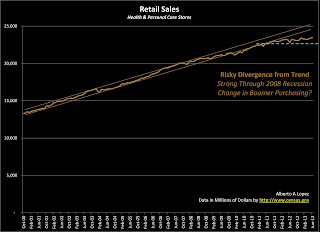
Data Graph of Retail Sales for Health and Personal Care Stores from January 2000 to June 2013
Retail Sales
January 2000 - June 2013

Health and Personal Care Stores
Take a look at all the charts. Even the best performers like Online and Food Retailers display a recessionary elbow as part of the curve during 2008. Now look at this chart of the Personal Care category. It could be argued that there is no elbow. My feeling is that females of the Baby Boomer generation might have compromised on everything they bought for the family during the recession; everything that is but their cosmetics. If there was ever a generation of well pampered residents, theirs would be it.
But now, after risk has supposedly subsided, the chart has broken out of its long term trend. The diverging gap is in fact growing. In my opinion, this tells a very dark story about the near to mid term future for these retailers. We are at least 10 years away from seeing the children of these Boomer moms start buying the same Personal Care products and services. In fact, it is my experience that when they do come on board as clients, the younger generation will not buy the same products or shop at the same stores. I would therefore watch for innovators withing the category and stay away from any retailer that can't cover its cost of capital. For about a decade now, things may get very tough.

Hurray for US Shoppers 
 In general, retail sales have demonstrated that American consumers continue to be the most reliable economic force in the global economy. While China slows down trying to control a renegade real estate market and Europe comes to the realization that incomes must be matched by productivity, the US remains the best and most desirable market in the world. People all over the planet are willing to buy our securities at ridiculous prices despite fiscal irresponsibility and political dysfunction. I believe that, at the end of the day, there are two great reasons that make all of it happen; and both are tied to American people.
Our companies are more innovative because our people. Our Retailers have experienced resilient sales thanks also to our people. Whether as a shopper or as an innovator, each American person has bought our incompetent government more time to try to get us back on track. Hurray for US Shoppers.

Friday, July 12, 2013

2013 Top 20 Business Books List (Part II)

Q&A Section
  • Question: Can you Recommend Any Good Business Books for Executives?
  • Answer: Absolutely (Part 2)! 
This is part two of my 2013 Top 20 Business Books List. If you missed the first installment, you may prefer to start there. In part one, I discussed ten books under the categories of Economics, the Environment, Human Resources, Leadership, Marketing and Operations. Today, we will end the list by going over the books on Strategy. Yes, half of the books in the list resided in just this one category. By using trader lingo, we could say that I am overweight Strategy.
Picture of Brown book over golden marble table with 2013 Top 20 Business Books List on cover
2013 Top 20 Business Books List
Why so many Strategy books? A reason could be that Strategy is important in business. Another more mundane reason may be that bookstores offer many more books dealing with Strategy than any other business subject; something I didn't test.
The real reason why my list is overweight Strategy is that it includes three series. There are three books by Clayton Christensen, three more by Peter Drucker and two additional ones by Jim Collins. Think of it this way: if each author was represented by a single book the total number of books under this section would be five; half as many.
While there is a high risk of repetition when suggesting various books from a single author, I did not make the choices lightly. Each book series was highly influential in my professional life. In all cases, every book was needed to get a complete message from the author.
Enjoy this the second part of my 2013 Top 20 Business Books List.


Strategy

Clayton Christensen
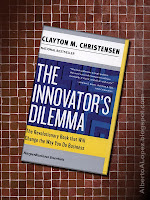
Beauty shot picture of book by Clayton Christensen, "The Innovator's Dilemma", "When New Technologies Cause Great Firms to Fail"
When New Technologies 
Cause Great Firms to Fail;
Clayton Christensen
We start with a trilogy that offers the latest in strategic thinking. Clayton Christensen, Professor of Business Administration at the Harvard Business School, created three fantastically insightful books. Each builds on the previous.
Thus, I suggest to start with The Innovator's Dilemma, then follow with The Innovator's Solution and end with Seeing What's Next. While each book offers new and independent ideas, they are all elegantly interconnected. Christensen's concepts are effective either way, in isolation or grouped together. It is this balance between individuality and unity that makes me think so highly of his books.
Through three three books, Christensen gives structure to a series of concepts; all tremendously important for business.
Beauty shot picture of book by Clayton Christensen and Michael Raynor, "The Innovator's Solution", "Creating and Sustaining Successful Growth"
Creating and Sustaining 
Successful Growth;
Clayton Christensen
Through his work, he suggests that strategic decisions made by businesses are binary in nature. There are just right or wrong choices. Right decisions propel the business far ahead of competitors and industry standards. Wrong decisions, on the other hand, hold the business back in mediocrity. The implied message is that all organizations continuously make the wrong choices.
His logical frame begins with an analysis of what happens when innovation disrupts an industry. How do market participants respond? What do market leaders do? What are the available alternative routes? What happens when each of such routes is selected?
Beauty shot picture of book by Clayton Christensen and Scott Anthony, "Seeing What's Next", "Using Theories of Innovation to Predict Industry Change
Using Theories of Innovation 
to Predict Industry Change;
Clayton Christensen
Next, he identifies and explains the common patterns he found. With superior insight, he disproves generally accepted business beliefs that will inevitably take a company to its perish. He breaks with tradition. From there, he studies the predictability of future performance based on corporate action.
Is your head spinning yet? Yes, all that I just wrote is quite cryptic. To me, everything makes sense. But to someone who has not read the books, these words probably sound like gibberish. If I am being a little ornery, it's because I want to make sure that you read these books and discover on your own. I don't want to give too much away.
From all that I have learned over the years, I have come across many neat techniques and ideas. But I found it almost impossible to discover new fundamentally based concepts. That's why these three may be the most important books I own today. In the future, as their prescriptions evolve from strategic advantages to best practices, there may be other more important books. But for now these three are the best in this list. As you read them, try to prevent the natural tendency to simply follow the text. Instead, I recommend that you stop periodically to make an inventory of what the book just described. Along that way, you will get the best from the them.
These three books are too valuable. As an executive, you can't afford not to read them. Start now.


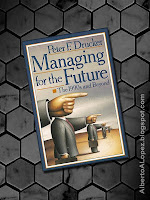
Beauty shot picture of book by Peter Drucker, "Managing for the Future", "The 1990's and Beyond"
The 1990's and Beyond;
Peter Drucker
Born right after the turn of the 20th century, Peter Drucker had a front row seat to the nation's evolution from an aspiring and disorderly bunch, to leaders of the economic and military worlds.
From his great perspective, he was able to discern distinct macro patterns from the otherwise noisy global picture. Peter Drucker used insights from such patterns throughout his professional life. He became the most prodigious business thinker of the century.
The three books included here describes these patterns in an extensive fashion.
He notes, for example, that coal and the steam engine had a similar effect on the economy as today's computers. Coal and the steam engine gave birth to the locomotive. Likewise, computers gave birth to the internet. Both locomotives and the internet reduced distances and opened new markets. Just like locomotives created a global economic boom, so would the internet.
Beauty shot picture of book by Peter Drucker, "Managing in a Time of Great Change"
Managing in a Time 
of Great Change;
Peter Drucker
Early in his career, he recognized the impact that knowledge would have on productivity. Along the way, he coined the term knowledge worker. Later he would dedicate much of his effort to further develop his understanding of knowledge workers, the elements that drove their productivity and their emotional makeup.
Some have recognized Drucker as the father of modern business. During most of the first half of the 20th century, corporate managers studied law rather than business. At the time, there was no such thing as a business school.
Drucker has also been credited with applying strategy to business. Prior to such change, strategy was exclusively associated with war.
Beauty shot picture of book by Peter Drucker, "Managing in the Next Society"
Peter Drucker
As if these accolades weren't enough, Drucker was too the personal adviser to Jack Welch. Much of what Jack describes in his books were originally conceived during meetings between the two giants.
It should be evident by now that a collection of books that does not contain Drucker is simply incomplete. He has greatly impacted what we now know as business. He can't be missed.
It is incredible to think that his books are full of new and relevant ideas, even by today's standards. Just imagine how much of a revelation were his innovations 40 years ago.
Yes, there are a couple of repetitions within the three books. The idea of a knowledge worker, for example, is mentioned in all of the books. But Drucker is too important of an erudite for lazy research. Besides, each book covers a broad selection of different topics. So I had to include them all. I enjoyed these books greatly and so should you.


Jim Collins
Beauty shot picture of book by Jim Collins, "Good to Great", "Why Some Companies Make the Leap...and Others Don't"
Why Some Companies Make 
the Leap...and Others Don't;
Jim Collins
Everyone has a theory of what makes a good company. These beliefs are clearly visible in the way we conduct business.  But the reality is that no one really knows with a high degree of scientific certainty whether what they think is valuable or just voo-doo.
No one, that is, except Jim Collins. His first book, Good to Great, became a sensation precisely because it offered strong evidence that contradicted many widely held beliefs. Collins conducted an exhaustive study of public company data that lead him to many important conclusions. He framed these conclusions with the question: what makes a Good company become Great?
And that is how it all started. Collins applied regression analysis to determine how Good companies became much better than their peers. His first book documents the methodology he used and the results obtained.
Beauty shot picture of book by Jim Collins and Jerry Porras, "Built to Last", "Successful Habits of Visionary Companies"
Successful Habits of 
Visionary Companies;
Jim Collins
Very impressive is the fact that he was able to turn a scholarly document of such data-rich nature into a narrative that any manager could follow.
How do great companies set goals? What do they do or stop doing? What are the characteristics of their employees and leaders?
After dominating such a beast of a project, it occurred to Jim and his team that they should try to conquer an even greater challenge; their aim was to transcend time. They wanted to know what does it take to create a company that could outlast all other? Where there any special kind of founding principles? What about culture and practices? Was the leader's vision important?
I hope that by now you are excited with anticipation. The two books are fantastic and should be read in order, to get the most out of them. Jim is clear in his delivery. The ideas are all actionable on their own or as part of a complete restructuring effort. Best of all, his findings fit nicely with results from many other great researchers.
They are so good that you will want to share these books with everybody in your team.


Thomas Friedman
Thomas Friedman, multiple Pulitzer Prize winner for The New York Times, offers one of the most relevant geo-economic insights of our time.
Beauty shot picture of book by Thomas Friedman, "The World Is Flat", "A Brief History of the Twenty-First Century"
A Brief History of the 
Twenty-First Century;
Thomas Friedman
During one his many travels abroad, he noticed a pattern. The international playing field was beginning to level. The gaps in information, market transparency and access to resources between people in advanced nation, like the US, and those living in places like India begun to converge. It was this leveling that inspired the name of the book. The World is Flat describes how, for the first time and thanks to the internet and the digital age, people in faraway places are beginning to participate at a more equal level in our markets.
When I hear employees complain that the Chinese are taking their jobs, I reply that the Chinese are also fighting for my job. Even business owner's risk losing their job to business owners abroad. You see, the Chinese have a deeper commitment to becoming educated than most Americans. While we are trying to stop schools from giving homework to our children, Asians are often upset when homework is too easy or when there isn't science work for students to do at home. Now that many great colleges are offering free education online, it is a real shame that the only ones taking advantage of it are foreigners.
Then add the fact that Asians have a solid work ethic and you now can see the challenge. They are willing to learn more, work harder and get paid less. Even Steve Jobs once said that it was difficult for Americans to compete with the Chinese to make the iPhone. But the problem is not limited to factory workers and other forms of skilled labor. There is an incredible amount of new patents being created by Chinese divisions of companies like Microsoft. In no time, China will graduate more engineers than the US and the pressure on knowledge workers will increase. This should be a warning to doctors who think that they will always be able to charge as much as they want. Many X-ray charts are already being evaluated by experts in India overnight, for example.
A hungry and aggressive manager in China with such an educated and dedicated team, could easily push an American company into failure; ending all future-wealth dreams of the North American business owner.
For the first time, this book made me realize that we have now extended the major leagues to include additional and very competitive teams and players from abroad. Competition will therefore get tougher rather than easier.
The change is inevitable. We should stop complaining and start working faster and more effectively. It is time to stop the leisure that so many people in this country feel entitled to.
Always do remember that all these new comers don't want us to fail. They just want to drive the same BMW's. You will enjoy this book very much.


Kenneth Gronbach
Would you like to know what the future holds for your industry? How about any other industry? There is a method that renders a future economic forecasts of unbelievable accuracy.
Beauty shot picture of book by Kenneth Gronbach, "The Age Curve", "How to Profit from the Coming Demographic Storm"
How to Profit from the Coming 
Demographic Storm;
Kenneth Gronbach
Births are the only event that takes place in the past that can also offer a window into the future. While Harry Dent is perhaps the best known of the practitioners of demographic based analysis, it wasn't until Gronbach's book that I came across the concept. I therefore credit Gronbach with helping me understand it. The book is easy to read and his examples are clear and relevant.
Why did the number of Honda motorcycle dealers decline after Top Gun? The movie hit theaters everywhere and created a great image for the products. Why did sales decline despite Honda's better engineering, better products and more competitive prices? Even the extensive marketing campaigns couldn't prevent revenue losses.
The reason behind this tragic business tail is that new wives do not approve of street rockets for their new husbands. Want to understand more? Read the book.
I will warn you that it'll be too easy to dismiss any ideas as being nice but unimportant for daily use. Bad managers keep their schedule busy by running from fire to fire. They are chaos experts. Like five-year-old's playing soccer, these leaders are data-dependent. They cluster together chasing the ball rather than running to where the ball will be. Like with soccer, it takes maturity to get a manager to see beyond the short term. This is why I believe that a great manager has the ability to compartmentalize short, medium and long term goals in a way that none is ignored. We should always keep an eye on all three of these periods regardless of the number of emergencies at hand.
The information contained in this book will fit nicely in the long term compartment. This is not because demographic-driven events never take place. No. It is because the long term eventually turns into medium and then short term. All demographic considerations thus transform from data into actionable strategy.

2013 Top 20 Business Books List
While it is difficult to recall every important fact in so many books, especially those I read over ten years ago, I aimed at creating a comprehensive list that could serve as a great informational foundation for any executive. Now that the list of complete, I hope that you find it relevant and valuable.